
What to Expect at Auschwitz-Birkenau

Visiting Auschwitz-Birkenau is one of the most emotionally and historically significant experiences a person can have. Expect a solemn, deeply affecting journey through two sites covering approximately 5–7 km of walking over 3.5 hours. You will see original buildings, authentic artefacts, ruins of gas chambers, and exhibitions documenting the systematic murder of over 1.1 million people. The site demands — and rewards — full presence and preparation.
If you have never visited a Holocaust memorial site before, you may not know quite what to expect. The images and stories you have encountered — from books, films, or history lessons — will be confronted by physical reality in a way that those sources cannot prepare you for. The scale, the silence, and the evidence all combine into something that stays with most people for the rest of their lives.
This guide is written to help you prepare thoughtfully — emotionally, practically, and logistically — so that your visit is as meaningful as it should be.
Before You Arrive: Preparing Yourself
The most important thing to understand before visiting Auschwitz-Birkenau is that this is not a conventional tourist attraction. It is a memorial site and a crime scene preserved in place — the actual ground on which over a million people were murdered. Arriving with that understanding, rather than treating the visit as a sightseeing activity, is the foundation of everything.
Many visitors — including those who consider themselves well-read on the Holocaust — report being profoundly surprised by the emotional impact of the visit. The physical reality of standing in the same spaces, seeing the original objects, and grasping the scale of Birkenau cannot be replicated by any account or image.
A few things worth doing before your visit:
- Read a first-person survivor account. Primo Levi’s If This Is a Man and Elie Wiesel’s Night are the most widely read; both are available in most languages.
- Watch the museum’s own introductory film shown in the cinema near the entrance, which provides historical context before the guided tour begins.
- Avoid fictional accounts that misrepresent the historical reality — in particular The Boy in the Striped Pyjamas and The Tattooist of Auschwitz, both of which contain serious historical inaccuracies that can distort expectations.
Arriving at the Memorial
Arrive at the main entrance at 55 Więźniów Oświęcimia Street at least 30 minutes before your booked entry time. Security checks are thorough — your bag will be inspected and your identity document will be verified against the name on your personalised entry pass. The name on your ID must exactly match the name on your pass; discrepancies can result in refusal of entry.
Bags larger than 35×25×15 cm cannot be brought into the museum and must be left in your vehicle or in the on-site luggage storage, which carries a small fee. Read our full guide on what to wear and bring for the complete list of restrictions and practical packing advice.
If you have booked through an organised guided day tour from Kraków, your guide or tour leader will manage the security process and entry logistics for you — one of the significant practical advantages of booking this way.
The Atmosphere on Site
The atmosphere at Auschwitz-Birkenau is unlike anywhere else. The museum maintains an environment of solemnity and respect throughout. Visitors are expected to speak quietly, move respectfully through the site, and conduct themselves with full awareness of where they are.
This is not performative. The site is, in the most literal sense, a cemetery — the remains of many victims were never recovered, and human ashes are present in the ground throughout Birkenau. Read our full guide to rules of conduct and visitor etiquette before your visit.
What You Will See at Auschwitz I
The tour begins at Auschwitz I, the original camp. You will walk through the gate bearing the notorious inscription “Arbeit Macht Frei” — Work Sets You Free. Learn more about the history and significance of this gate and what it meant to the prisoners who passed beneath it.
Inside the camp, the tour moves through the exhibition blocks:
Block 4 presents the evidence of mass extermination: documentation of the deportation transports, the organisation of the killing process, and the fate of those who arrived at the camp.
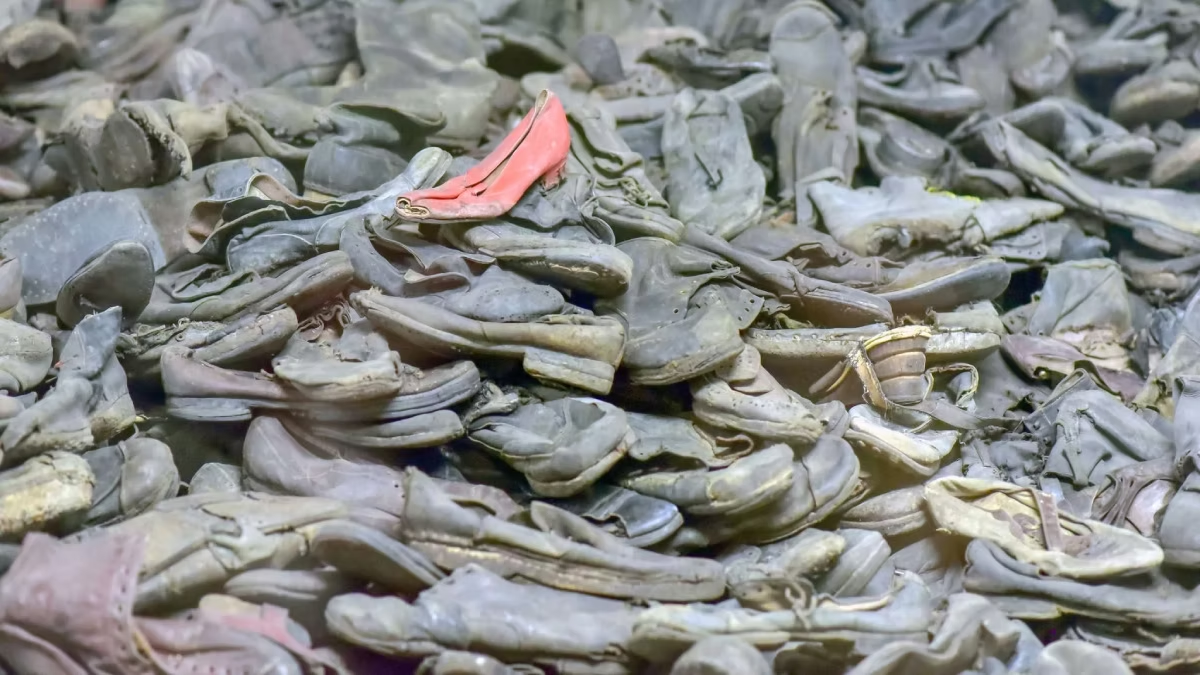
Block 5 contains the physical evidence of the crime — personal belongings of victims: suitcases, shoes, glasses, prosthetic limbs, and the single most disturbing display in the museum: a room containing nearly two tonnes of human hair shorn from victims before their murder. Photography is not permitted in this room.
Block 6 documents the lives of registered prisoners: registration photographs, the tattooing of prisoner numbers, and the conditions of daily life inside the camp.
Block 11 — the Death Block was the camp prison. The standing cells in the basement — four prisoners forced to stand through the night in a space the size of a telephone box — and the starvation cells are among the most disturbing spaces in the museum. The Wall of Death in the courtyard between Blocks 10 and 11 was the site of thousands of executions by shooting.
The Auschwitz I portion of the tour ends at the original gas chamber and Crematorium I, where the first experimental killings using Zyklon B were carried out. Photography is prohibited inside the gas chamber itself.
What You Will See at Auschwitz II-Birkenau
Auschwitz II-Birkenau is where the scale of the crime becomes fully apparent. The site covers nearly 175 hectares — an area so large that its full extent only becomes clear from the watchtower above the main gate. Standing at one end and looking down the central axis of the camp, towards the ruins of the gas chambers over a kilometre away, is one of the defining experiences of a visit to Auschwitz-Birkenau.
After a short break, a free shuttle bus transports visitors to Birkenau. The tour begins at the railway ramp — the platform from which arriving prisoners were selected for forced labour or immediate death. You will walk the route that those sent directly to death took from the ramp to the gas chambers.
You will pass through the prisoner barracks — many original, some reconstructed — and begin to understand the conditions of extreme overcrowding, inadequate sanitation, and near-starvation in which registered prisoners lived and died.
The visit ends at the ruins of the gas chambers and crematoria — deliberately blown up by the SS in January 1945 as they retreated — and at the International Monument to the Victims at the far western end of the site. Many visitors spend time here in silence. Take the time you need.
The Emotional Reality
Most visitors describe the emotional experience as heavier and more lasting than they anticipated. Feelings of grief, numbness, anger, and disbelief are all normal responses. The site does not manage or soften these emotions — it presents the evidence and allows visitors to respond as individuals.
There is no single correct emotional response to Auschwitz-Birkenau. Some people cry. Some fall silent for hours afterwards. Some feel a moral urgency about the present that changes their outlook. All of these are valid.
If you are visiting with children — particularly younger ones — be aware that the museum recommends the visit is not suitable for children under 14, due to the nature of the exhibitions and the graphic evidence on display. Our guide to visiting Auschwitz with children addresses this in detail.
Give yourself space after the visit. Many visitors do not want to immediately move on to another activity. Time to process — whether in quiet, in conversation, or in further reading — makes the experience more meaningful in the long run. Our guide to after your visit includes recommended books, films, and resources for continued engagement.
Practical Things to Know
Photography: Permitted throughout both sites for personal purposes, without flash and without a tripod. Prohibited inside the Block 4 hair room and inside the basement of Block 11. Read the full photography rules guide.
Facilities: Paid toilets and a café are located near the main entrance and at Birkenau. There is no free drinking water on site — bring your own, particularly in summer. The on-site bookshop carries a wide selection of historical publications in multiple languages.
Mobile phones: Calls should not be made on the museum grounds. Photography and navigation apps are acceptable. If you need to take a call, step outside the museum perimeter.
Eating on site: Food and drink are not permitted inside the buildings or on the camp grounds themselves. Eating is restricted to the café areas near the site entrances.
Frequently Asked Questions
Is visiting Auschwitz worth it?
Yes — unreservedly. Auschwitz-Birkenau is one of the most important historical sites in the world, and the physical experience of being there is categorically different from any book, film, or documentary. Most visitors describe the experience as among the most significant of their lives. The question to ask is not whether to visit, but how to prepare so that the visit is as meaningful as it deserves to be.
Is Auschwitz upsetting to visit?
Yes. Auschwitz-Birkenau is deeply affecting — more so than most visitors anticipate, even those with strong prior knowledge of the history. The experience is not frightening in a visceral sense; it is emotionally overwhelming in a way that engages your conscience as much as your feelings. Most visitors describe the impact as lasting well beyond the day itself.
Do I need a guide at Auschwitz?
For a first-time visit, a licensed museum educator-guide is very strongly recommended. The physical spaces alone convey scale but not the full depth of what happened. A guide provides the historical framework, the individual human stories, and the narrative continuity that transforms the visit into something genuinely comprehensible. Self-guided visits are permitted at certain times, but the museum itself advises against them for first-timers. See our full comparison of guided vs self-guided visits.
Can I take photos at Auschwitz?
Photography for personal purposes is permitted throughout both sites without flash or tripod. Two specific areas are excepted: the room containing victims’ hair in Block 4, and the basement of Block 11. Full details in our photography rules guide.
What should I wear to Auschwitz?
Dress modestly and appropriately for the occasion — the site is a place of mourning and the dress code reflects that. Comfortable, broken-in walking shoes are essential given the 5–7 km of walking involved. Dress for the weather, particularly at Birkenau which offers little shelter. Read our complete what to wear and bring guide.
Is Auschwitz suitable for children?
The museum recommends the visit is not suitable for children under 14, due to the graphic nature of the exhibitions and the emotional weight of the site. The decision ultimately rests with parents. If visiting with younger children, the museum has a supervised childcare facility near the entrance. Our guide to visiting Auschwitz with children covers this in full.
What happens if I arrive late for my entry slot?
The museum operates a strict timed-entry system. If you arrive after your scheduled time you may not be admitted. Always arrive at least 30 minutes before your booked slot to allow for security checks. If you are on an organised tour, your guide manages the timing — a significant practical advantage.
