
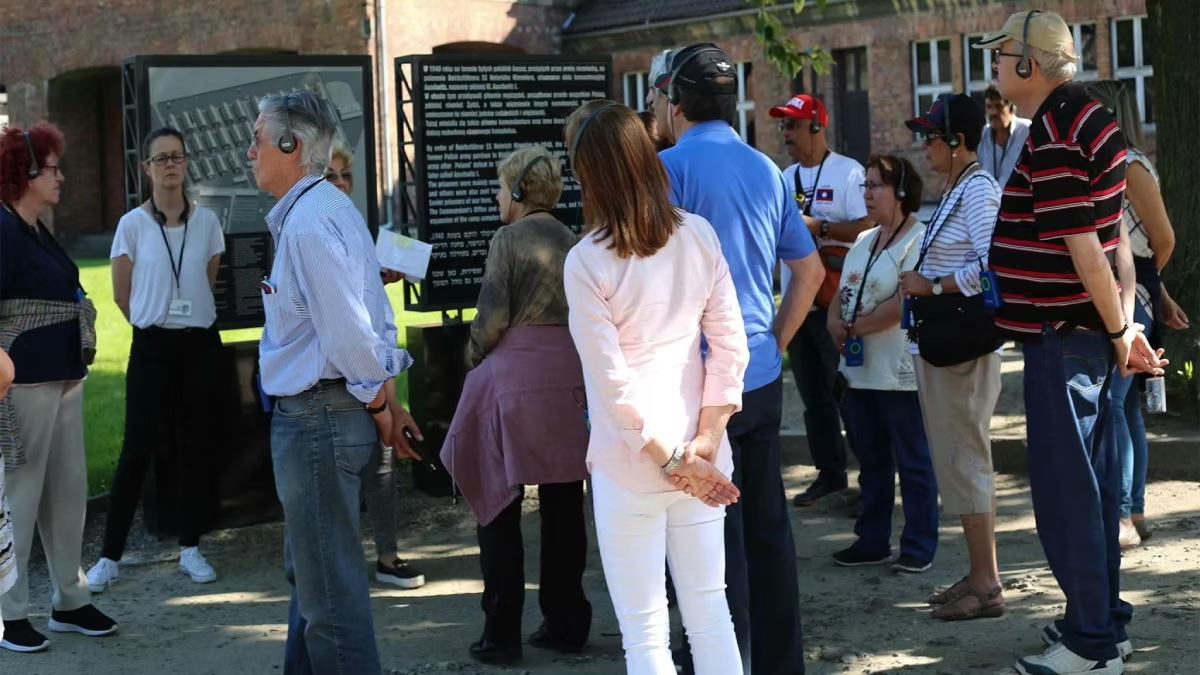
Guided Tour vs Self-Guided Visit at Auschwitz-Birkenau

For a first-time visit to Auschwitz-Birkenau, a guided tour led by a licensed museum educator is strongly recommended — by the museum itself, by experienced visitors, and by this guide. The physical spaces at Auschwitz-Birkenau convey scale and atmosphere; the historical context required to fully comprehend what happened there requires expert explanation. Self-guided visits are available at certain times for individuals, and suit return visitors or those with strong prior knowledge, but are not the right default for most first-time visitors.
This is one of the most genuinely useful decisions you will make when planning a visit to Auschwitz-Birkenau, and it deserves a considered answer rather than a quick one. This guide gives you both.
What Each Option Actually Means
A Guided Tour
A guided tour at Auschwitz-Birkenau is led by a licensed museum educator-guide — a professional trained specifically by the Auschwitz-Birkenau Memorial Museum to conduct tours on site. No external guide, however experienced, is authorised to lead tours within the grounds. Only museum-certified educators can do this.
During a guided tour, the educator-guide:
- Leads your group through both Auschwitz I and Birkenau in a structured sequence
- Provides historical and contextual commentary at each location — the story of individual prisoners, the decisions made by the Nazi command, the specific function of each building or space
- Uses archival photographs and documents to illustrate the history
- Answers questions from the group throughout
- Manages timing and movement between sites, including coordinating the shuttle bus to Birkenau
Groups of more than 10 people are provided with headsets so all members can hear the guide clearly across the outdoor sections of both sites.
A Self-Guided Visit
A self-guided visit means entering the grounds with a free personalised entry pass — available at specific times via visit.auschwitz.org — and exploring independently. There is no educator-guide accompanying you.
During a self-guided visit:
- You move at your own pace, spending as much or as little time as you choose at each location
- You rely on the exhibition panels within the blocks, the museum’s printed guidebook (available in multiple languages at the bookshop), and your own prior knowledge
- You are not on a fixed tour route — you may prioritise the spaces that matter most to you
- The free shuttle between Auschwitz I and Birkenau is available for self-guided visitors who have booked at the appropriate time (confirm when booking)
Self-guided passes are available only at certain hours and are subject to availability, which is limited compared to guided tour slots.
The Case for a Guided Tour
The museum’s own position is unambiguous — it recommends visiting with a guide, particularly for first-time visitors. The reasons are specific to the nature of this site.
The history is dense and requires contextual framing. Walking through Auschwitz I and seeing the blocks, the exhibitions, the gas chamber, and Block 11 without knowing the sequence of events that led to each — the escalation of the Nazi programme, the specific decisions about which groups to target, the timeline of the “Final Solution” — means walking through evidence without understanding what you are seeing. A guide provides that framework.
Individual human stories transform the experience. The most powerful moments in any Auschwitz-Birkenau guided tour are not the statistics — they are the specific accounts of individual prisoners: the man whose suitcase you can see in the vitrine, the woman whose photograph is in Block 6, the child who arrived on a particular transport. Guides bring these stories into the visit. Exhibition panels cannot replicate this.
The guide manages what is not on any map. Experienced educator-guides know where to pause, what to say at the gas chamber ruins, how to allow silence at the International Monument. They have absorbed years of training not just in history but in how to present this history with appropriate sensitivity. The rhythm of a well-guided tour is part of what makes the visit as affecting as it should be.
Groups of 10 or more have no choice. The museum’s mandatory guide requirement for groups of 10 or more is a firm policy. If you are visiting as a school group, a corporate delegation, or any other pre-formed group of 10+, a guided tour is not optional. Read our group visits guide for full details.
The Case for a Self-Guided Visit
A self-guided visit is the right choice in specific circumstances, and it should not be dismissed as an inferior option for those circumstances.
Return visitors. If you have already completed a guided tour of Auschwitz-Birkenau and want to return — to spend more time at specific sites, to revisit spaces that affected you most, or to engage with the exhibitions at your own pace — a self-guided visit is a natural and appropriate format.
Visitors with strong prior knowledge. Someone who has studied Holocaust history extensively — a historian, an educator, a survivor’s family member with deep personal engagement with the history — may find a self-guided visit allows them to engage with the site on their own terms, without the structure of a group tour.
Those who need to move at their own pace. For visitors with anxiety, sensory sensitivities, or mobility needs that make a group tour format difficult, a self-guided visit offers flexibility. You can spend as long as you need at each space, step away when you need to, and re-enter areas without being constrained by the group’s movement.
Budget constraints. The self-guided free entry pass carries no guide fee (~75 PLN saving per person). For visitors with genuine cost constraints, a self-guided visit with a good preparatory grounding in the history is significantly better than not visiting at all.
What Self-Guided Visitors Should Do Before Arriving
If you choose to visit self-guided, preparation before you arrive makes a substantial difference. The museum itself stresses this.
Read a first-person account. Primo Levi’s If This Is a Man or Elie Wiesel’s Night are the most widely recommended. Both are short enough to read in a day or two and provide the human grounding that makes the physical spaces comprehensible.
Read a historical overview of Auschwitz specifically. The museum’s own educational resources at auschwitz.org/en/education are free and authoritative.
Pick up a printed guidebook on arrival. The museum bookshop near the entrance carries detailed printed guides in multiple languages that provide written context for each major site. These are worth purchasing before beginning your visit.
Consider the online tour as preparation. The museum’s live online guided tour (~2 hours) is specifically useful as a preparatory session before a self-guided in-person visit. See our online virtual tours guide for details.
Cost Comparison
| Option | Entry | Guide Fee | Total On-Site Cost |
|---|---|---|---|
| Guided tour (museum, 3.5h) | Free | ~75 PLN | ~75 PLN |
| Self-guided visit | Free | None | Free |
| Organised day tour from Kraków | Included | Included | ~130–250 PLN total incl. transport |
Availability: An Important Practical Note
Self-guided free passes are available only at specific hours and in limited numbers — they are not available at all times during the day. During peak summer months (July–August), self-guided slots can be harder to secure than guided tour slots. If you are planning a self-guided visit in summer, book your free pass as far in advance as possible at visit.auschwitz.org.
Guided tour slots are also subject to availability, but the range of available times throughout the day is typically broader than for self-guided passes.
Frequently Asked Questions
Is a guide necessary at Auschwitz-Birkenau?
For groups of 10 or more, yes — a licensed museum educator-guide is mandatory. For individuals, it is not legally required, but it is strongly recommended by the museum for first-time visitors. The historical depth of the site is significantly harder to engage with without expert contextual guidance. For return visitors or those with strong prior knowledge, a self-guided visit is a valid and meaningful option.
Can you visit Auschwitz without a guided tour?
Yes — individual visitors can book a free self-guided entry pass at specific times via visit.auschwitz.org. Self-guided visits are available at certain hours, subject to availability. Groups of 10 or more cannot visit without a licensed guide.
Is the self-guided visit at Auschwitz worth it?
For first-time visitors with limited prior knowledge of the history, a self-guided visit risks leaving you with scale and atmosphere but without the historical framework to make sense of what you are seeing. For return visitors, those with strong prior knowledge, or those with budget constraints who prepare thoroughly in advance, a self-guided visit can be deeply meaningful.
How do I book a self-guided visit to Auschwitz?
Via visit.auschwitz.org. Select “Visit for Individuals,” then choose “Tour for individuals without an educator” and select an available time slot. Self-guided passes are free but personalised — the name on the pass must match your ID. Full booking instructions are in our how to book tickets guide.
Can I switch from self-guided to guided on the day?
Individual visitors at Auschwitz-Birkenau can sometimes join an existing guided group tour on the day if there is space, but this is not guaranteed. If you want a guided tour, book it in advance through visit.auschwitz.org rather than relying on joining a tour on the day.
