
The Prisoner Exhibitions at Auschwitz I: Blocks 4, 5 & 6

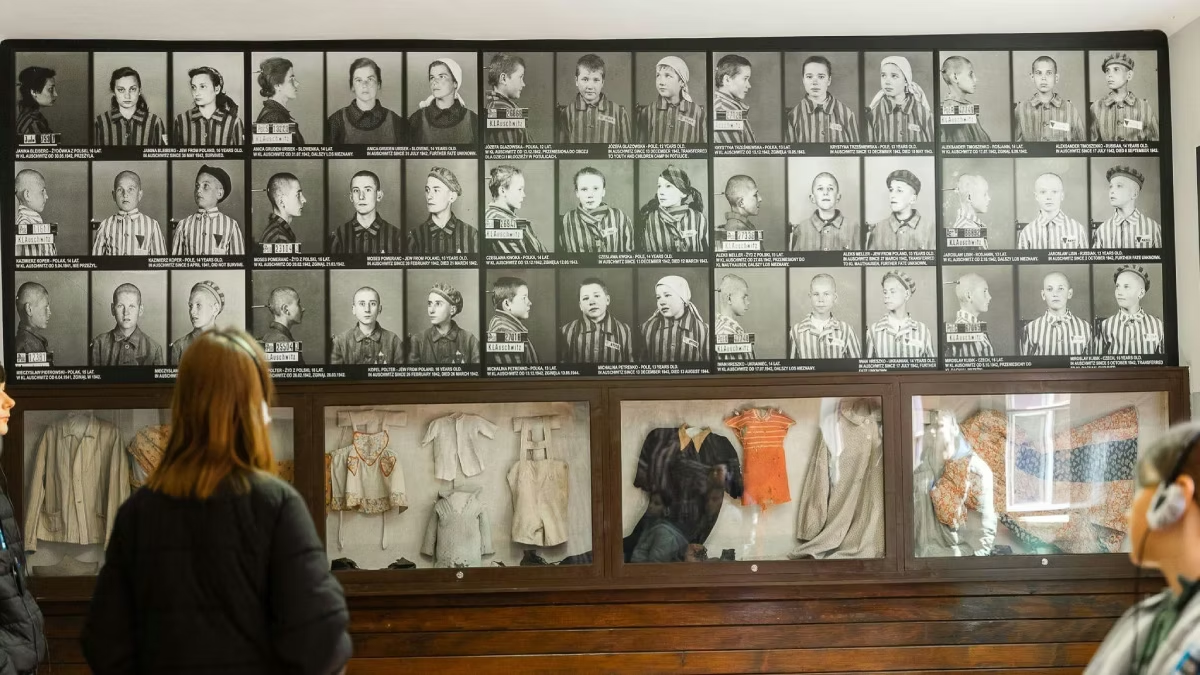
Blocks 4, 5, and 6 at Auschwitz I house the museum’s core permanent exhibitions. Block 4 documents the process of mass extermination, including the hair room (photography prohibited). Block 5 displays the personal belongings confiscated from victims on arrival — shoes, suitcases, glasses, and children’s clothing. Block 6 documents the lives of registered prisoners and displays their registration photographs. Together, these three blocks form the emotional and evidential heart of Auschwitz I.
Of all the buildings at Auschwitz I, Blocks 4, 5, and 6 are where the museum’s permanent exhibitions most directly confront visitors with the human reality of what happened here. They move from the administrative and documentary evidence of the mass murder programme (Block 4) to its physical evidence (Block 5) to the individual human beings who were its victims (Block 6). Visiting all three, in sequence, is an experience that most visitors describe as unlike any other museum encounter they have had.
Block 4: Evidence of Mass Extermination
Block 4 is the museum’s exhibition on the process and mechanics of mass murder at Auschwitz-Birkenau. It is the most difficult of the three blocks to engage with directly, and the most important.
The deportation transports. The exhibition opens with documentation of the deportation of Jews from across German-occupied Europe to Auschwitz-Birkenau. Maps, train manifests, and photographs show the systematic scope of the operation — transports arriving from Poland, Hungary, France, the Netherlands, Greece, Italy, and across the continent.
The selection process. Photographs and testimony document the “selection” conducted by SS physicians on the railway ramp at Birkenau on arrival — who was sent to forced labour registration, and who was sent directly to the gas chambers. This selection applied to virtually all children under 15, their mothers, the elderly, and anyone deemed unfit for work. Those selected for immediate death typically represented 70–80% of each arriving transport.
The killing process. The exhibition documents the operation of the gas chambers at Birkenau — the procedure by which victims were deceived into believing they were going to shower, the introduction of Zyklon B, the death process, and the removal and cremation of bodies.
The hair room. One room in Block 4 contains approximately two tonnes of human hair in a large glass-fronted display. The hair was shorn from victims before or after death and found by Soviet investigators at liberation — the SS had not managed to ship it to factories, where it would have been used in the manufacture of textiles and other industrial products.
The hair room in Block 4 is one of two locations at Auschwitz-Birkenau where personal photography is strictly prohibited. The prohibition is an act of dignity for the victims. Signs at the entrance to the room make this clear, and museum staff are present to enforce it.
Standing before the hair display is one of the most overwhelming moments at the entire memorial for most visitors. The quantity — tonnes of human hair — makes the numbers undeniable. Photographs cannot adequately prepare you for the physical reality of what is in that room.
Block 5: The Personal Belongings of Victims
If Block 4 documents the murder programme, Block 5 displays its physical evidence: the belongings confiscated from prisoners on arrival and found at liberation by Soviet forces.
The shoes. A room contains over 80,000 shoes — displayed floor to ceiling behind glass along the length of the room. The shoes are the belongings of murdered victims, collected on arrival before the gas chambers, sorted, and stored for shipment back to Germany. The variety — children’s shoes, fashionable women’s shoes, work boots, sandals, orthopaedic shoes — makes the range of individuals represented tangible.
The suitcases. The suitcases are particularly affecting for a specific reason: many bear the names, addresses, and dates of birth of their owners, written on the outside per the Nazis’ instructions that luggage be clearly labelled for “collection after the shower.” The names are real. The people who wrote them were told to do so as part of the systematic deception that preceded their murder.
Other belongings. The exhibition also displays glasses, prosthetic limbs, shaving brushes, shoe-polishing equipment, pots and pans, and other household items — the ordinary objects of ordinary lives, brought to Auschwitz-Birkenau because the people who owned them were told to bring what they needed.
Children’s clothing. A separate display of children’s clothing — small shoes, tiny coats, children’s dresses — is among the most difficult sections of the Block 5 exhibition. The scale of what was done to children at Auschwitz-Birkenau is one of the hardest facts to absorb; the physical evidence of the clothing makes it impossible to abstract.
Block 6: The Lives of Prisoners
Block 6 shifts the perspective from the mass murder programme to the individual human beings who were registered as prisoners — those who survived selection on the ramp and entered the camp as forced labourers.
The registration photographs. The most recognisable element of Block 6 is a display of registration photographs — taken of prisoners by the SS on arrival as part of the bureaucratic process of induction into the camp. Men, women, and children are displayed in rows, each with their prisoner number, nationality, arrival date, and — in many cases — the date of their death.
The photographs are standard bureaucratic images: front view, side view, slightly downward angle. They were taken to facilitate identification for administrative purposes. Displayed in the museum context, they become something else entirely — individual faces, individual people, each of whom had a name, a history, a family. Many of those photographed died within days or weeks of their registration.
The tattooing process. Block 6 documents the tattooing of prisoner numbers on the left forearm — a practice unique to Auschwitz-Birkenau among the Nazi camps, adopted in 1941 when the scale of the camp made individual identification through other means impractical. The tattoo replaced the prisoner’s name. Survivors carried this number for the rest of their lives.
Daily life in the camp. The exhibition documents the conditions of prisoner existence: the barracks, the food (approximately 700 calories per day), the work details, the death roll calls, the punishment system, the struggle for survival. It makes clear that “survival” in Auschwitz-Birkenau was not passive — it required active negotiation of circumstances designed to kill.
The “Hair of Victims” note. The Block 6 exhibition does not repeat the hair display from Block 4, but it contextualises the human beings whose hair is displayed there. The photographs of prisoners in Block 6, viewed after Block 4, make explicit what the hair room makes viscerally clear: these were people.
Visiting the Three Blocks
The standard 3.5-hour guided tour covers all three blocks as part of the Auschwitz I section of the visit. Your educator-guide leads the group through each, providing context, individual stories, and the historical framework that connects the documentation to the human reality.
Sequence: The guided tour typically moves through the blocks in the order: Block 4 → Block 5 → Block 6, then continues to Block 11 and Crematorium I before the shuttle to Birkenau. This sequence is deliberately considered — it moves from evidence of the murder programme to its material traces to the individual human beings who were its victims.
Self-guided visitors: Block 4, 5, and 6 are all accessible on a self-guided visit during the hours when self-guided passes are available. The museum’s printed guidebook, available at the bookshop near the entrance, provides written context for each block.
Time: Allow at least 30–40 minutes per block if you want to engage with the exhibitions properly. The hair room in particular warrants time — many visitors spend 10–15 minutes in that room alone.
Frequently Asked Questions
What is in Block 4 at Auschwitz?
Block 4 houses the museum’s permanent exhibition on evidence of mass extermination. It documents the deportation transports, the selection process at the railway ramp, and the operation of the gas chambers. The most significant space is the hair room — a room containing approximately two tonnes of human hair shorn from victims, displayed behind glass. Photography in the hair room is strictly prohibited.
What is in Block 5 at Auschwitz?
Block 5 contains the personal belongings of victims confiscated on arrival — over 80,000 shoes, 3,800 suitcases (many bearing the names of their owners), glasses, prosthetic limbs, children’s clothing, and other objects. These are the actual belongings of the people who were murdered, preserved as evidence.
What is in Block 6 at Auschwitz?
Block 6 documents the lives of registered prisoners — those who survived selection and entered the camp as forced labourers. The most significant display is a wall of registration photographs: images taken by the SS on arrival, each marked with the prisoner’s number, arrival date, and often their date of death. Block 6 also documents the tattooing process, daily conditions in the camp, and the struggle for survival.
Can you photograph Block 5 at Auschwitz?
Yes — photography without flash is permitted in Block 5. The displays of shoes, suitcases, and other belongings are commonly photographed by visitors. Photography is prohibited only in Block 4’s hair room and in Block 11’s basement.
How long should I spend in Blocks 4, 5, and 6?
The standard guided tour spends approximately 30–40 minutes across all three blocks combined. Self-guided visitors who want to engage with each exhibition properly should allow 30–40 minutes per block. The hair room in Block 4 alone warrants at least 10–15 minutes.
