
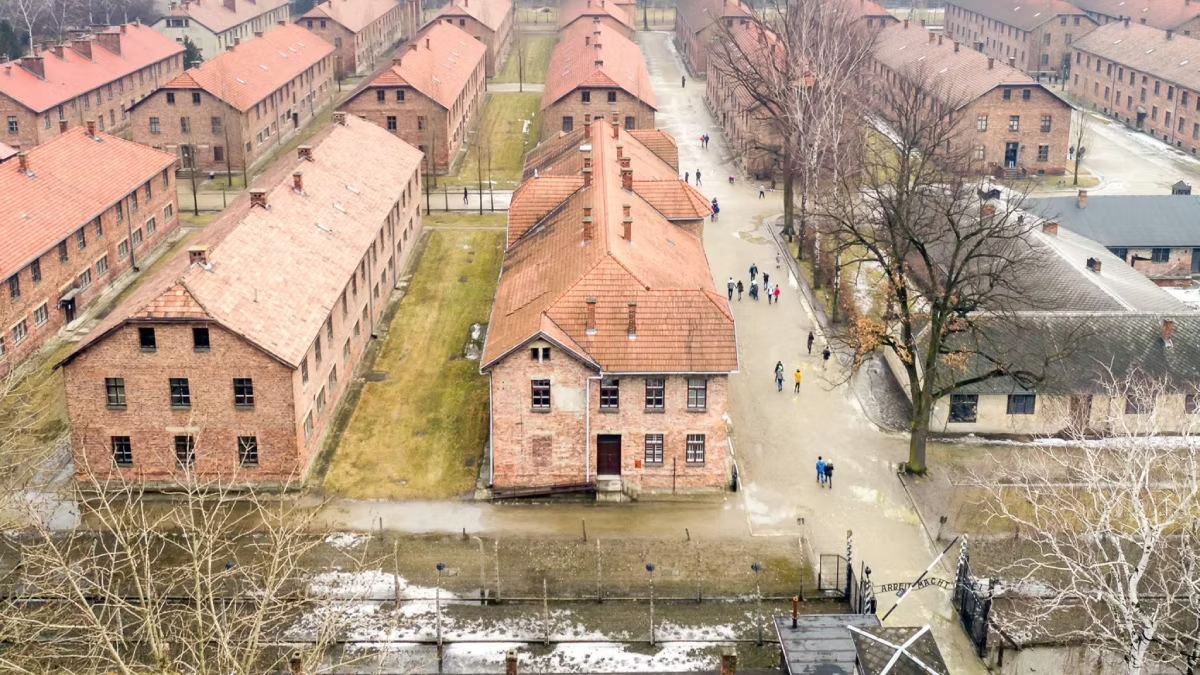
The Prisoner Barracks at Birkenau

Birkenau at its height contained over 300 prisoner barracks across multiple camp sections, housing men, women, and children in conditions of extreme overcrowding, malnutrition, and disease. Most of the barracks no longer exist — burned or demolished by the SS or collapsed over time. What remains are the rows of brick chimney stacks across the open field, each marking the location of a former barrack. Several original wooden and brick barracks survive and are open to visitors.
Walking through Birkenau and seeing the rows of chimneys stretching across the flat, open field is one of the most quietly devastating moments of the visit. It takes time to understand what you are looking at. Each chimney is not a ruin in itself — it is the ghost of a building that is no longer there. The building it belonged to once held hundreds of people. Across the field, there are dozens of rows of chimneys, and each row tells the same story.
The Layout of Birkenau
Birkenau was divided into multiple sections, each designated by a letter and Roman numeral. The main sections were:
- BI (BIa and BIb): The women’s camp, established in 1942. BIa and BIb were separated by an internal fence. This is the section containing the preserved wooden barracks open to visitors.
- BII: The main men’s camp, later divided into sub-sections including the family camp for Jews from Theresienstadt (BIIb), the Hungarian Jewish women’s camp (BIIc), the men’s camp (BIId), and the Gypsy family camp (BIIe).
- BIII (“Mexico”): An unfinished extension camp begun in 1944 but never completed.
At the height of the camp’s operation in 1944, the prisoner population of Birkenau exceeded 90,000 people.
The Wooden Barracks
The wooden barracks — the most widely photographed structures at Birkenau — were originally designed as horse stables for the German army, each intended to hold 52 horses. Without modification, they were repurposed to hold prisoners.
Each barrack was divided into stalls along both sides of a central aisle, with three-tier wooden bunks running the length of the building. Each “bunk” was a wooden shelf approximately 180 cm wide, shared by multiple prisoners. At the height of overcrowding, a single barrack held 800 or more people in a space designed for fewer than 60.
Conditions inside the barracks:
- No heating during the winter months in which temperatures regularly dropped well below freezing
- A single stove along the central aisle, which provided minimal heat and produced significant smoke
- No running water — prisoners had access to washing facilities only at designated and extremely limited times
- Two latrines for each barrack block, open only at specific times of day; prisoners caught outside during off-hours faced severe punishment
- A daily food ration of approximately 700 calories — a slow starvation ration
- No mattresses; prisoners slept on the bare wooden shelves, sharing a single blanket among multiple people
Disease was endemic and rapid in these conditions. Typhus, dysentery, tuberculosis, and starvation killed prisoners within weeks or months of their registration. The mortality rate in the Birkenau barracks was, by design, extreme.
Visiting the wooden barracks: Several original wooden barracks in the BIa section of the women’s camp survive and are open to visitors. Entering one and standing inside — seeing the three-tier bunks stretching the length of the building — makes the conditions viscerally comprehensible in a way that description alone cannot. The dimensions are not dramatic; the barracks are low-ceilinged and dark. The horror is in the arithmetic: this space, holding 800 people.
The Brick Barracks
The brick barracks were built to a more permanent standard than the wooden horse stables, but conditions inside were not meaningfully better. The brick structures provided some insulation against cold but were equally overcrowded, equally under-resourced, and equally deadly.
Several brick barracks survive in various sections of the camp and are accessible to visitors, though the interior exhibitions focus primarily on the wooden barracks section.
The Rows of Chimneys
The majority of Birkenau’s barracks no longer exist. Most were burned by the retreating SS in January 1945, or demolished in the post-war period, or simply collapsed from disrepair. What remains where each barrack once stood is the brick chimney stack that ran through the centre of the building — a structural element robust enough to survive where the wooden walls and roofs did not.
These chimney stacks — standing in precise rows across the open field, each spaced at the interval of a barrack’s width — are among the most affecting sights at the entire memorial. From the top of the main gate watchtower, the rows of chimneys stretch to the horizon, and the scale of what Birkenau was becomes suddenly, completely real.
Your educator-guide will explain what the chimneys represent at the beginning of the Birkenau portion of the tour. For many visitors, this explanation is the moment when the abstract statistics of Auschwitz-Birkenau — 1.1 million people, 300 barracks — become something they can actually see.
The Latrine and Washroom Blocks
Between the rows of barracks, the latrine and washroom blocks are preserved and accessible to visitors. The latrine block — a long building containing rows of open holes over a channel — provided the only toilet access for hundreds of prisoners, open for minutes twice a day. The washroom block provided minimal and controlled access to water.
These buildings are not dramatic, but they are important. They represent the daily reality of life in the camp — the systematic humiliation designed into every aspect of the prisoner’s existence.
Frequently Asked Questions
What were the barracks at Birkenau like?
The wooden barracks were converted horse stables, each holding up to 800 prisoners in a space designed for 52 horses. Prisoners slept on three-tier wooden shelves with no mattresses, minimal heating in winter, and a daily ration of approximately 700 calories. Disease was endemic and mortality within weeks or months of registration was common. The brick barracks provided marginally more permanent shelter but equally brutal conditions.
How many people lived in a Birkenau barrack?
At the height of overcrowding in 1944, a single wooden barrack designed for 52 horses held 800 or more prisoners. The three-tier wooden bunks along both walls of each stall were shared by multiple people, with a single blanket between them.
What do the chimney stacks at Birkenau represent?
Each brick chimney stack across the Birkenau field marks the location of a former prisoner barrack. The barracks themselves were burned or demolished — by the SS before liberation, or by deterioration afterwards — but the central chimney stack survived. The rows of chimneys stretching across the site represent the scale of the camp and the number of people imprisoned there.
Can you go inside the barracks at Birkenau?
Yes. Several original wooden barracks in the BIa section of the former women’s camp are open to visitors and can be entered as part of the guided tour. Standing inside a preserved barrack — seeing the three-tier bunks and understanding that 800 people occupied this space — is one of the most affecting experiences of the Birkenau visit.
Why are there so many chimneys but so few barracks at Birkenau?
Most of Birkenau’s 300+ barracks were destroyed — burned by the SS in January 1945 as they attempted to eliminate evidence before the Soviet liberation, or demolished or collapsed in the post-war decades. The brick chimney stacks were more structurally robust and survived where the wooden walls and roofs did not. The chimneys visible today are not ruins of the chimneys; they are the chimneys themselves, standing where the barracks once stood around them.
