
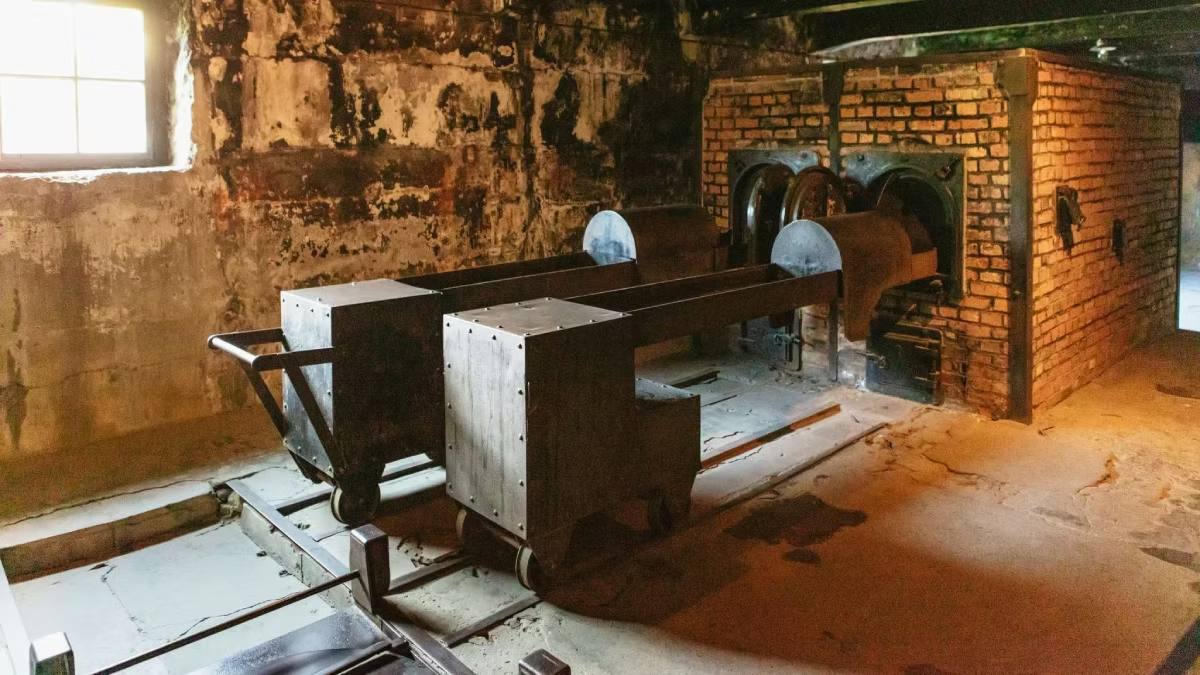
The Gas Chamber & Crematorium I at Auschwitz

Crematorium I at Auschwitz I is the first gas chamber built at the complex and the site of the first experimental killings using Zyklon B in September 1941. It served as a killing facility from 1941 to 1942, when the larger Birkenau crematoria replaced it. Visitors can enter the building and walk through the gas chamber. The building is partially reconstructed — the SS converted it to other uses and partially dismantled it before liberation. It is open to visitors as the final stop of the Auschwitz I section of the guided tour.
Standing in Crematorium I is the moment when the historical and the physical collapse into each other in a way that nothing else at the memorial quite replicates. This is the room where it began — where the Nazi administration first tested the systematic use of Zyklon B to murder human beings, found it efficient, and proceeded to apply that method at massive scale across the Birkenau crematoria. Walking through it is unlike anything else at Auschwitz-Birkenau.
What Crematorium I Was
Crematorium I was the first crematorium built at Auschwitz I, installed in 1940 initially for the purpose of incinerating the bodies of prisoners who died from disease, starvation, exhaustion, and individual executions within the camp. By 1941, as the prisoner population grew and as the Nazi programme of mass murder was being developed, it was expanded and converted into a combined gas chamber and crematorium.
In September 1941, a group of approximately 600 Soviet prisoners of war and 250 sick Polish prisoners were locked into the building, and Zyklon B — a pesticide used elsewhere in the camp for fumigation — was introduced through holes in the roof. All were killed. The experiment was considered a success by the SS. Rudolf Höss, the camp commandant, later described the event and his satisfaction with Zyklon B’s effectiveness.
Between 1941 and 1942, Crematorium I was used to murder thousands of prisoners — primarily Soviet POWs and Jews from the early deportation transports. Victims were told they were going to shower; they undressed in the adjacent undressing room and entered the gas chamber. The doors were sealed. Zyklon B crystals were dropped through the ceiling vents. Death occurred within 15–20 minutes.
In 1942, Crematorium I was taken out of service as a gas chamber when the much larger purpose-built crematoria at Birkenau (Crematoria II, III, IV, and V) became operational. Auschwitz I’s crematorium was converted by the SS into an air-raid shelter for camp personnel.
The Reconstruction
The building visitors see today is partially reconstructed. After liberation, Soviet investigators and the fledgling museum sought to restore it as evidence. The furnaces were re-installed, the interior walls were partially reconstructed, and the Zyklon B introduction vents were reopened in the ceiling. This reconstruction was carried out in the late 1940s and early 1950s.
The museum is transparent about the reconstruction. Explanatory signage at the building’s entrance describes what is original and what was restored. The goal of the reconstruction was to make the building’s function legible — to allow visitors to understand how the killing was carried out — rather than to present it as entirely original.
What Visitors See Today
The tour of Auschwitz I ends at Crematorium I. Visitors enter through the undressing room — a long, low-ceilinged space where victims were told to undress and remember where they had left their clothes, for collection after their “shower.” The door between the undressing room and the gas chamber is original.
The gas chamber: The gas chamber itself is a rectangular concrete room, low-ceilinged, with openings in the roof through which Zyklon B was introduced. The furnaces are visible through a doorway at the far end. The dimensions of the room make the scale of what happened here tangible — it is possible to stand in it and understand, viscerally, what the space was and what it was used for.
The furnaces: Three original crematorium furnaces stand at the end of the building, used to incinerate the bodies of those murdered in the gas chamber.
Photography: Personal photography inside Crematorium I is permitted, though many visitors choose not to photograph the gas chamber itself. The weight of the space leads most visitors to simply be present rather than document. Photography without flash; no tripod.
Why This Building Matters
Crematorium I is not where the majority of the murders at Auschwitz-Birkenau took place — that was Birkenau, where the four larger crematoria murdered over a million people between 1942 and 1944. Its significance is different: it is where the method was developed and first applied. Understanding Crematorium I means understanding how the industrialised murder of the Holocaust began — not with a grand plan fully formed, but with an experiment, a result deemed satisfactory, and an escalation.
The ruins of the Birkenau crematoria — deliberately destroyed by the SS — convey the scale of what followed. Crematorium I at Auschwitz I conveys the beginning.
Frequently Asked Questions
Can you go inside the gas chamber at Auschwitz?
Yes. Crematorium I — the first gas chamber at Auschwitz — is open to visitors, and you can walk through the interior, including the gas chamber itself. It is the final stop on the Auschwitz I portion of the guided tour.
Is the Auschwitz gas chamber original?
Crematorium I is partially reconstructed. The SS converted the building to an air-raid shelter before liberation, partially dismantling the gas chamber. After liberation, Soviet investigators and the museum partially restored it to its original configuration — reopening the Zyklon B introduction vents and reinstalling the furnaces. Explanatory signage at the building describes what is original and what was reconstructed.
When was Zyklon B first used at Auschwitz?
September 1941, in Crematorium I at Auschwitz I, when approximately 600 Soviet prisoners of war and 250 sick Polish prisoners were killed experimentally. The results were reported as satisfactory by the SS and led directly to the construction of the purpose-built extermination facilities at Birkenau.
What happened in Crematorium I at Auschwitz?
Crematorium I served as the first gas chamber and crematorium at the Auschwitz complex from 1941 to 1942. Victims — primarily Soviet POWs and Jews from early deportation transports — were told they were going to shower, directed into the gas chamber, and killed with Zyklon B introduced through ceiling vents. Their bodies were then cremated in the furnaces. In 1942, when the larger Birkenau crematoria became operational, Crematorium I was converted to other uses.
Is there photography allowed in the gas chamber at Auschwitz?
Photography is permitted inside Crematorium I, including in the gas chamber itself. Many visitors choose not to photograph the gas chamber — the weight of the space and what it represents leads them to simply be present. Photography without flash; no tripod. Photography is prohibited in the Block 4 hair room and Block 11 basement, but not in Crematorium I.
