
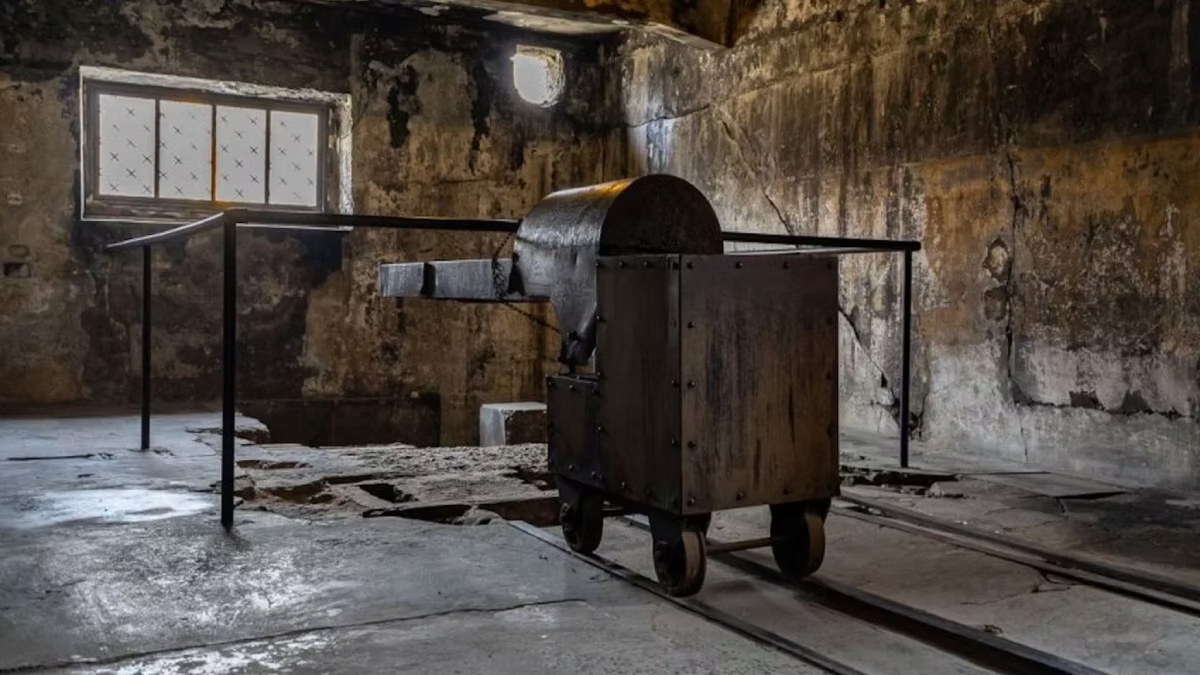
The Gas Chambers & Crematoria at Birkenau

Birkenau contained four purpose-built gas chamber and crematorium complexes — Crematoria II, III, IV, and V — operational from 1943. Together they were capable of murdering and incinerating thousands of people per day. In late 1944, as Soviet forces approached, the SS dynamited all four to destroy evidence of the crimes committed there. The ruins are preserved in their destroyed state and are among the most visited and most significant sites at the entire memorial.
The crematoria at Birkenau were not improvised or makeshift. They were purpose-designed industrial facilities, contracted to German engineering firms, constructed according to detailed architectural plans, and operated by the SS with bureaucratic precision. Understanding that they were the product of deliberate planning — not spontaneous violence — is essential to understanding what they represent.
Background: Why Birkenau Needed Larger Facilities
Crematorium I at Auschwitz I — where Zyklon B was first used to murder human beings in September 1941 — had a limited capacity. As the Nazi regime accelerated the deportation and murder of Jews from across Europe, it became clear that a much larger killing infrastructure was needed.
Construction of four new crematoria at Birkenau began in 1942. Each combined a gas chamber — disguised as shower facilities — with a crematorium for the incineration of bodies. The complexes were designed by the firm Topf and Sons, which also supplied the furnaces. By March 1943, all four were operational.
Crematoria II and III
Crematoria II and III were the largest of the four complexes, located at the end of the railway ramp on opposite sides of the track. They were mirror images of each other in design.
Each consisted of:
- An undressing room below ground, where victims were told to undress and remember where they had left their belongings for collection after the “shower”
- A gas chamber below ground — a large concrete room with Zyklon B introduction vents in the ceiling, disguised as shower heads
- Cremation furnaces on the ground floor above — five triple-muffle furnaces per crematorium, capable of incinerating the bodies of those murdered below
The capacity of each crematorium was approximately 1,440 bodies per 24-hour period, though during peak operations in 1944 this was significantly exceeded.
The bodies of victims were moved from the gas chamber to the furnaces by members of the Sonderkommando — Jewish prisoners forced to work in the crematoria under threat of their own death.
In November 1944, as the Soviet advance accelerated, the SS ordered the dismantling of the crematoria. In January 1945, days before liberation, they were dynamited. The ruins of Crematoria II and III — collapsed concrete slabs, the outlines of the underground chambers still visible, twisted reinforcing rods — stand at the end of the Birkenau railway ramp.
Crematoria IV and V
Crematoria IV and V were built to a different design — above-ground gas chambers rather than underground. They stood on the opposite side of the camp from Crematoria II and III.
Crematorium IV was the site of the Sonderkommando uprising of 7 October 1944 — the largest armed revolt within Auschwitz-Birkenau. Members of the Sonderkommando, knowing they were about to be killed and replaced, attacked their SS guards using tools and smuggled gunpowder. Crematorium IV was set on fire during the uprising. All of the Sonderkommando members who participated were killed, but their act of resistance — and the historical record they helped preserve by burying documents within the camp — is a crucial part of the site’s history.
The ruins of Crematoria IV and V stand slightly apart from the main ramp area. A pond adjacent to the ruins was used to scatter the ashes of victims.
The Destruction of the Evidence
The deliberate destruction of the crematoria by the SS is itself significant. In the final months of the war, Heinrich Himmler ordered the dismantling and destruction of the extermination facilities — an attempt to erase the evidence of what had been done there before the Allied armies arrived.
The ruins visitors see today are therefore not the result of neglect or time — they are the result of deliberate demolition by those who operated the facilities. The broken concrete, the collapsed chambers, the exposed rebar: this is what evidence destruction looks like. And it failed. The ruins themselves became evidence.
What Visitors See Today
The ruins of Crematoria II and III are accessible and visited as part of every standard guided tour. Visitors can walk among the collapsed structures, see the outlines of the underground gas chambers and undressing rooms in the broken concrete, and stand at the site where hundreds of thousands of people were murdered.
The ruins of Crematoria IV and V are visible from the main tour route and accessible to visitors, though they are not always included in the standard 3.5-hour tour. They are included in the 6-hour study tour.
Photography: Photography throughout the Birkenau site, including at the crematorium ruins, is permitted without flash or tripod. Many visitors choose to photograph the ruins as a form of bearing witness; others prefer simply to be present.
The Sonderkommando Scrolls
Among the most important historical documents related to the crematoria are the Sonderkommando scrolls — written accounts buried within the Birkenau grounds by members of the Sonderkommando before their deaths, recovered after liberation. These documents, written by people who operated the crematoria under duress and knew they would be killed to prevent their testimony, describe in precise detail how the gas chambers functioned.
The scrolls are among the most direct eyewitness accounts of the killing process ever recovered. They are held at the Auschwitz-Birkenau State Museum and are referenced in the permanent exhibitions.
Frequently Asked Questions
How many gas chambers were at Birkenau?
Birkenau had four crematorium complexes — Crematoria II, III, IV, and V — each incorporating one or more gas chambers. Together they were capable of murdering thousands of people per day. Crematorium I at Auschwitz I was an earlier, smaller facility that predated the Birkenau crematoria.
Why did the SS destroy the crematoria at Birkenau?
As Soviet forces approached in late 1944 and early 1945, Heinrich Himmler ordered the destruction of the extermination facilities to eliminate evidence of the mass murders conducted there. The SS dismantled and dynamited all four Birkenau crematoria. The attempt to destroy the evidence failed — the ruins, the buried Sonderkommando accounts, and the testimony of survivors provided extensive documentation of what had occurred.
Can you go inside the gas chambers at Birkenau?
The gas chambers at Birkenau were destroyed by the SS before liberation. What remains are ruins — collapsed concrete structures in which the outlines of the underground chambers are visible but the spaces are no longer intact. Visitors can walk among the ruins and see the remains of the structures, but there are no intact interior spaces to enter as there are at Crematorium I at Auschwitz I.
What was the Sonderkommando?
The Sonderkommando were Jewish prisoners forced by the SS to work in the crematoria — removing bodies from the gas chambers, operating the furnaces, and performing related tasks. They were kept isolated from the rest of the camp and were periodically killed and replaced to prevent testimony from surviving. On 7 October 1944, members of the Sonderkommando staged an armed uprising, destroying Crematorium IV before being killed.
What is the pond near the Birkenau crematoria?
The pond near the ruins of Crematoria IV and V was used by the SS to scatter the ashes of victims after cremation. It remains on site, unmarked except in the context of the guided tour and the site’s interpretive panels. It is one of the most sobering locations at Birkenau.
