
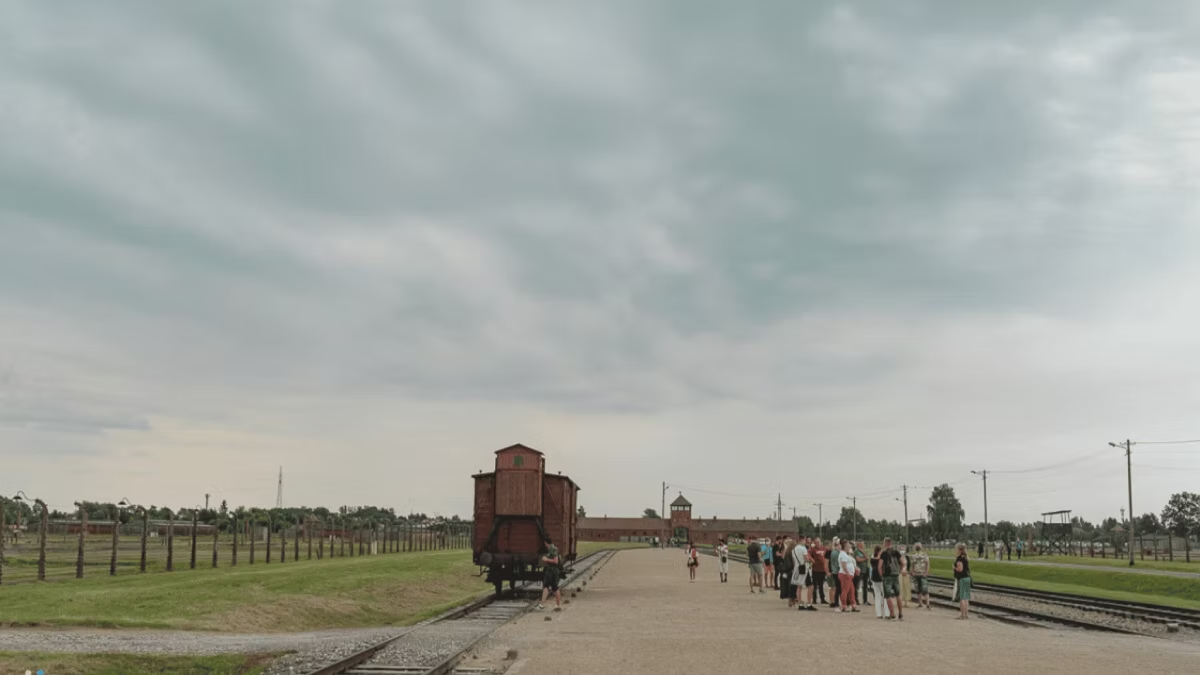
The Railway Ramp at Birkenau

The railway ramp at Birkenau is the platform alongside the railway track inside the camp where arriving deportees disembarked from transport trains and underwent the SS selection process. Those deemed fit for forced labour were registered as prisoners; the remainder — typically 70–80% of each transport, including almost all children — were taken directly to the gas chambers. The ramp, the railway tracks, and the surrounding area are preserved in their original state and are visited as part of every guided tour of Birkenau.
No single location at Auschwitz-Birkenau concentrates the mechanism of mass murder more precisely than the railway ramp. This is where arriving human beings — who had often been travelling for days in sealed freight wagons without food, water, or sanitation — stepped onto the platform and were subjected to a process that determined, within minutes, whether they would live or die. Understanding what happened here, and how it worked, is essential to understanding Birkenau.
The History of the Railway Ramp
The Original Ramp (1942–1944)
The first railway ramp used for deportation transports arriving at Auschwitz-Birkenau was not inside the camp itself. From 1942 to May 1944, arriving trains stopped on a siding between Auschwitz I and Birkenau — a location known as the “old ramp.” Prisoners were unloaded there and marched or transported to the camp.
The Birkenau Ramp (1944–1945)
In May 1944, as the deportation of Hungarian Jews began — the largest single deportation operation in the history of the Holocaust — the railway line was extended directly into the Birkenau camp and a new ramp was constructed inside the gates. This allowed the entire selection process to take place within the camp perimeter, out of sight of the outside world, and allowed the gas chambers to operate at maximum efficiency.
The new internal ramp ran from the main gate to the end of the camp, where it terminated in front of the crematoria. Between May and July 1944, approximately 437,000 Hungarian Jews were deported to Auschwitz-Birkenau on this ramp — the majority of them murdered within hours of arrival.
The Selection Process
The selection conducted on the railway ramp was carried out by SS physicians — most notoriously Dr. Josef Mengele, though many other SS doctors participated. The process was designed to appear administrative and routine, to prevent panic among the arriving prisoners.
As deportees stepped off the train, they were directed to form two columns — men and women separated. An SS physician walked along each column, pointing left or right. In practice, the criteria were simple: anyone who appeared capable of heavy forced labour — primarily men aged approximately 15 to 45 in apparent good health — was directed to one side. Everyone else — children, mothers with children, the elderly, the sick, pregnant women, and anyone else deemed incapable of immediate labour — was directed to the other.
Those selected for labour were marched to the registration process: they were tattooed, their heads were shaved, they were issued prisoner uniforms, and they entered the camp.
Those not selected — typically 70–80% of every transport — were told they were going for a shower and delousing before being assigned to barracks. They were directed along the road between the crematoria, told to remember where they had left their belongings, and led into the underground changing rooms beneath the gas chambers. The doors were sealed. Zyklon B was introduced. Death occurred within 15–20 minutes.
In many cases, from the moment a transport arrived at the ramp to the completion of the killing in the gas chambers took less than two hours.
What Visitors See Today
The railway ramp, the tracks, and the immediate surroundings are preserved in their original state. The steel rails run from the main gate through the centre of the camp to the end of the ramp, terminating in front of the ruins of Crematoria II and III.
Walking the ramp: On a guided tour, your educator-guide leads the group along the ramp, explaining the selection process with specific reference to individual transports and documented testimonies. The walk from the main gate to the end of the ramp is approximately 500 metres — a distance that takes a deportee’s journey from the train to the gas chamber and makes it physically real.
The end of the ramp: At the far end of the track, the ruins of the crematoria are immediately visible on both sides. The proximity of the end of the railway line to the entrance to the gas chambers — a matter of metres — makes the industrial logic of the operation viscerally clear.
The memorial plaques: Near the end of the ramp, a series of memorial plaques in multiple languages marks the site. These are among the most visited in the memorial and are typically where guided tours pause for a moment of reflection before continuing to the International Monument.
Individual Stories: The Human Scale
The selection statistics — 70–80% of each transport sent directly to death — are almost impossible to absorb in the abstract. Educator-guides at Birkenau typically use individual documented stories to make the numbers human.
One of the most widely cited is that of the Hungarian Jewish transport of 16 May 1944: a train carrying 3,300 people, of whom 2,500 were selected for the gas chambers on arrival. Among them were virtually all the children and their mothers. A handful of survivors from this transport gave testimony at post-war trials; their accounts describe the ramp, the walk, and the moment they understood what was happening.
These stories — told by your guide at the location where they took place — are the most affecting part of the Birkenau visit for many visitors.
Frequently Asked Questions
What was the railway ramp at Birkenau?
The railway ramp was the platform inside Birkenau where arriving deportation trains stopped and prisoners underwent the SS selection process. Those deemed fit for forced labour were registered; the rest — typically 70–80% of each transport, including almost all children — were sent directly to the gas chambers. The ramp was in use from May 1944, when the railway line was extended inside the camp gates, until the camp’s liberation in January 1945.
What happened to people who arrived at Auschwitz by train?
On arrival, deportees were unloaded onto the ramp and subjected to a selection conducted by SS physicians. The selection determined who would be registered as a prisoner and forced to work, and who would be taken immediately to the gas chambers. Most people who arrived — particularly children, the elderly, and mothers with children — were killed within hours of the train’s arrival.
Who conducted the selection at Birkenau?
SS physicians conducted the selection, rotating duty on the ramp. The most notorious was Dr. Josef Mengele, who was present on the ramp frequently from May 1944 onwards and who also conducted criminal medical experiments on prisoners within the camp. Many other SS doctors participated in selections — it was a routine duty rather than the work of a single individual.
How long did the selection process take?
The selection itself — the walk along the ramp with an SS physician pointing left or right — took only minutes per person. From the arrival of a transport to the completion of the killing in the gas chambers typically took less than two hours in total.
Can you walk on the railway ramp at Birkenau?
Yes. The ramp, the tracks, and the surrounding area are accessible to all visitors. On a guided tour your educator-guide leads the group along the ramp as part of the Birkenau section of the visit. Self-guided visitors can walk the full length of the ramp from the main gate to the ruins of the crematoria.
