
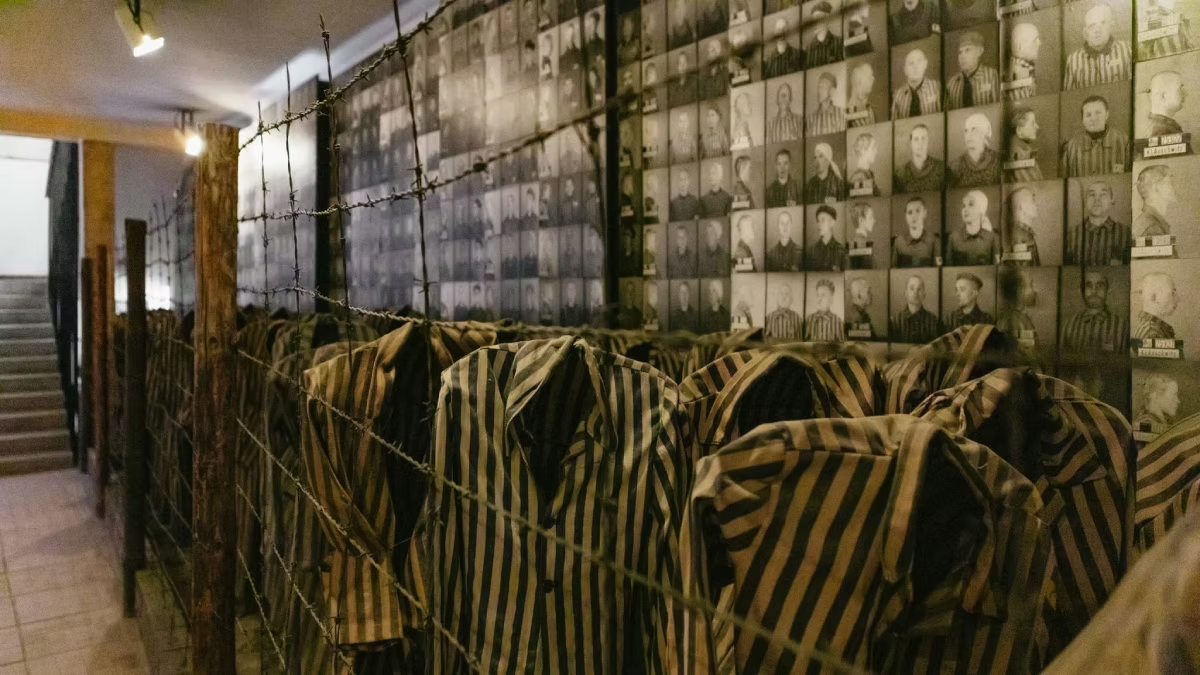
Block 11: The Death Block

Block 11 was the camp prison within Auschwitz I — the most feared building in the camp. It housed the SS Gestapo court, the standing cells in the basement (tiny spaces where prisoners stood through the night as punishment), and the starvation cells where prisoners were condemned to death without food or water. The courtyard between Block 10 and Block 11 contains the Wall of Death, where thousands of prisoners were shot. Photography is prohibited throughout the basement. The building is open to visitors as part of the standard guided tour.
Prisoners called it the Death Block. Its formal function within the camp administration was as a detention facility for those accused of violations — escape attempts, acts of resistance, contact with the outside world. Its actual function was to be a place of systematic torture, trial without due process, and execution. Of all the buildings at Auschwitz I, Block 11 is the one that most confronts visitors with the individual human experience of suffering within the camp.
What Block 11 Was
Block 11 served several distinct functions simultaneously:
The camp prison: Prisoners from across the entire Auschwitz complex — including Birkenau and Monowitz — were brought to Block 11 to face punishment. The most common charges were escape attempts, theft of food, contact with civilians outside the camp, or alleged resistance activities.
The SS Gestapo court: Block 11 housed the court established by the camp Gestapo to try prisoners for internal violations. Trials were cursory and outcomes essentially predetermined. The court sentenced prisoners to death, to flogging, to time in the standing cells, or to assignment to the standing work details where survival was measured in days.
A site of criminal medical experimentation: The cells of Block 10 (directly adjacent to Block 11, not publicly accessible) were used for criminal medical experiments conducted by SS physicians on female prisoners. Block 11’s courtyard — the Wall of Death — was where those condemned by the experiments were executed.
A death facility within the death camp: Even within the broader context of Auschwitz-Birkenau, Block 11 was understood by prisoners as the place from which return was least likely.
The Basement: Standing Cells and Starvation Cells
The basement of Block 11 is the most disturbing physical space in Auschwitz I. It is accessible to visitors as part of the guided tour, but photography is prohibited throughout.
The Standing Cells
Four standing cells occupy the basement of Block 11. Each is a roughly 90 cm × 90 cm brick-walled space, entered through a small hatch at floor level approximately 50 cm square. Prisoners sentenced to the standing cells were forced to crawl through the hatch, stand in the cell throughout the night — sometimes with three or four other prisoners in the same space — and then report for their regular work detail the following morning.
The punishment was typically imposed for periods of several nights. Death from exhaustion, suffocation, or cardiac failure in the standing cells was not uncommon. The cells could not be used for extended periods without killing the prisoner — which was frequently the intent.
The Starvation Cells
The starvation cells — also in the basement — were used for a more direct sentence of death. Prisoners condemned by the SS court were placed in a cell without food or water and left until death. The sentence was typically handed down as a response to escape attempts, particularly those that involved the death of an SS guard.
Maximilian Kolbe: In July 1941, following the escape of a prisoner from Auschwitz I, the camp authorities selected ten prisoners at random from the escaped prisoner’s block for death by starvation in Block 11’s basement — a standard reprisal policy. One of the ten selected was Franciszek Gajowniczek, who cried out that he had a wife and children. A fellow prisoner, Franciscan friar Maximilian Kolbe, stepped forward and volunteered to take his place. Kolbe was accepted by the SS and condemned to Cell 18. He survived longer than most — reportedly leading prayers and singing hymns with the other condemned men — and was finally killed by a phenol injection on 14 August 1941. Maximilian Kolbe was canonised by Pope John Paul II in 1982.
Cell 18 is marked and accessible to visitors. It is one of the most visited individual spaces within Block 11.
The Wall of Death
The Wall of Death stands in the narrow courtyard between Block 10 and Block 11. This is where prisoners sentenced to death by the SS court were executed by shooting. The procedure was carried out against the wall — prisoners were stripped to the waist, brought from the Block 11 cells, and shot individually.
Thousands of prisoners were executed at the Wall of Death throughout the camp’s operation, the majority of them Polish political prisoners. The wall was also used for mass executions following prisoner trials and reprisals for escape attempts.
The original wall was demolished by the SS in 1944 as part of the broader effort to destroy evidence of their crimes before the Soviet advance. The wall visible today is a reconstruction on the original site.
Flowers and memorial lights are placed at the wall by visitors year-round. It is a space of reflection and of considerable solemnity, even within a site defined by solemnity. Guided tours typically pause here in silence.
Visiting Block 11
Block 11 is included in the standard 3.5-hour guided tour of Auschwitz I and Birkenau. Your educator-guide will lead the group through the building’s interior and the basement, explaining the function of each space and the stories of specific prisoners.
Photography: Photography throughout the basement of Block 11 is prohibited. Photography in the upper floors and of the building’s exterior is permitted. Photography in the courtyard at the Wall of Death is permitted.
Emotional preparation: The basement of Block 11 is one of the most psychologically challenging spaces in the entire memorial. The physical dimensions of the standing cells — which visitors can look into through the hatches — make the punishment tangible in a way that description alone cannot. Many visitors find the basement more difficult than any other space at Auschwitz I, including the gas chamber.
Frequently Asked Questions
What is Block 11 at Auschwitz?
Block 11 was the camp prison within Auschwitz I — the most feared building in the camp. It housed the SS Gestapo court, standing cells in the basement (tiny spaces where prisoners were forced to stand through the night as punishment), starvation cells where prisoners were condemned to death without food or water, and served as the destination for prisoners from across the Auschwitz complex accused of violations.
What are the standing cells at Auschwitz?
The standing cells are four spaces in the basement of Block 11, each approximately 90 cm × 90 cm, entered through a small floor-level hatch. Up to four prisoners were forced into each cell to stand throughout the night as punishment before reporting for their regular work detail. Death from exhaustion was not uncommon. The cells are accessible to visitors; photography is prohibited throughout the basement.
Who was Maximilian Kolbe?
Maximilian Kolbe was a Polish Franciscan friar imprisoned at Auschwitz who in August 1941 voluntarily took the place of a fellow prisoner condemned to death by starvation in Block 11’s basement. He survived longer than others in the cell and was finally killed by a phenol injection. He was canonised as a saint by Pope John Paul II in 1982. His cell, Cell 18, is marked and visitable in Block 11’s basement.
What is the Wall of Death at Auschwitz?
The Wall of Death is a reconstructed wall in the courtyard between Block 10 and Block 11, on the site of the original wall where thousands of prisoners — predominantly Polish political prisoners — were executed by shooting. The original wall was demolished by the SS in 1944. The reconstruction stands on the original site and is marked by flowers and memorial lights.
Can I photograph Block 11?
The building’s exterior and upper floors may be photographed. Photography is prohibited throughout the basement of Block 11, including in and around the standing cells and starvation cells. Photography at the Wall of Death in the courtyard is permitted. Signs at the basement entrance make the prohibition clear.
