
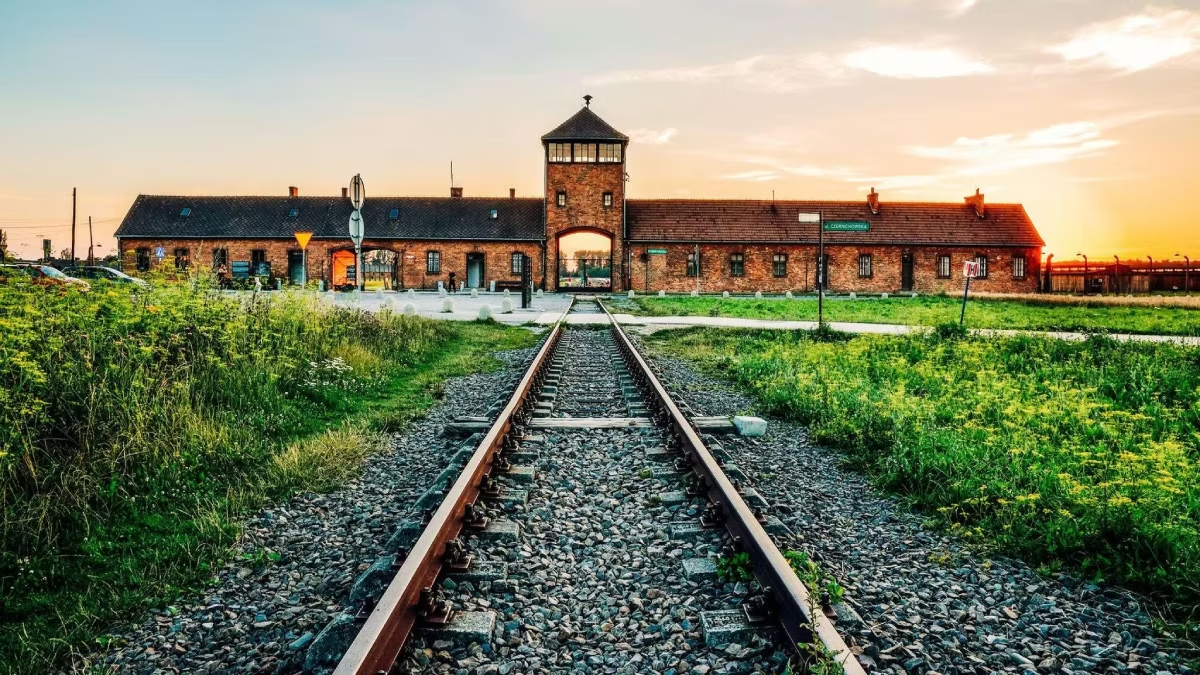
What is Auschwitz-Birkenau?

Auschwitz-Birkenau was the largest Nazi German concentration and extermination camp, operating from 1940 to 1945 near the Polish town of Oświęcim. More than 1.1 million people — the vast majority of them Jewish — were murdered there during the Holocaust. Today it is preserved as a UNESCO World Heritage Site and the Auschwitz-Birkenau State Museum, visited by over 1.8 million people annually from around the world.
Few places carry the weight that Auschwitz-Birkenau does. To stand within its grounds is to be confronted with the most extensively documented act of industrial genocide in human history — and to understand, at least in part, why remembrance remains so urgent today.
This guide explains what Auschwitz-Birkenau is, how it came to exist, what happened there, and everything you need to know before planning your visit to this profoundly significant memorial site in southern Poland.
The History of Auschwitz-Birkenau
Auschwitz-Birkenau was established by Nazi Germany in May 1940 in occupied southern Poland, near the town of Oświęcim — known in German as Auschwitz. The first prisoners were Polish political detainees. Within two years, the site had been transformed into the centrepiece of the Nazi regime’s programme of mass extermination.
The camp complex eventually comprised three main sites. Auschwitz I, the original camp, functioned as the administrative headquarters of the entire complex, constructed in pre-war Polish army barracks. Auschwitz II-Birkenau, built from 1941 onwards, became the largest and most lethal part of the system — a vast killing facility spanning nearly 175 hectares on the outskirts of the village of Brzezinka (Birkenau in German). Auschwitz III-Monowitz was a forced-labour camp built to service a nearby synthetic rubber plant operated by the IG Farben chemical corporation.
From 1942 onward, deportation trains carrying Jewish men, women, and children from across German-occupied Europe arrived at the railway ramp at Birkenau. On arrival, SS physicians conducted selections on the platform: those deemed capable of forced labour were registered as prisoners; the rest — including virtually all children, mothers with infants, the elderly, and anyone considered unfit for work — were taken directly to the gas chambers and murdered, typically within hours of their arrival.
The camp was liberated by Soviet forces on 27 January 1945. That date is now observed internationally as Holocaust Remembrance Day.
The Scale of the Crime
Historians estimate that at least 1.1 million people were murdered at Auschwitz-Birkenau between 1940 and 1945. Approximately 960,000 were Jewish. Others included around 74,000 Polish political prisoners, 21,000 Roma and Sinti people, 15,000 Soviet prisoners of war, and tens of thousands of individuals from other groups across occupied Europe.
The numbers are almost impossible to comprehend in the abstract. At its peak in the summer of 1944 — during the deportation of Hungarian Jews — the crematoria at Birkenau were operating continuously, incinerating the bodies of up to 10,000 people per day.
To understand this at a human scale, the exhibitions at Auschwitz I preserve the physical evidence of what was confiscated from victims upon arrival: 3,800 suitcases bearing their owners’ names and addresses, more than 80,000 shoes, 12,000 kitchen utensils, and nearly two tonnes of human hair. These are not statistics. They are the belongings of individuals.
Auschwitz Today: A Memorial and Museum
The Auschwitz-Birkenau State Museum was formally established by the Polish parliament on 2 July 1947, just two years after liberation, largely at the initiative of survivors who insisted the site be preserved as evidence. It was inscribed as a UNESCO World Heritage Site in 1979 — uniquely, as a site of negative heritage, preserved not as a place of pride but as irrefutable physical testimony to a crime against humanity.
The museum today encompasses the preserved grounds of both Auschwitz I and Auschwitz II-Birkenau, located approximately 3.5 kilometres apart. Auschwitz I contains 30 original brick buildings, many of which now house the museum’s permanent and national exhibitions. Auschwitz II-Birkenau preserves the ruins of the gas chambers and crematoria — deliberately destroyed by the retreating SS — alongside hundreds of original prisoner barracks, watchtowers, and kilometres of original fencing.
Admission to the grounds is free of charge, though visiting with a licensed museum educator-guide is strongly recommended for anyone coming for the first time. Entry passes must be reserved in advance via the official booking system at visit.auschwitz.org — no walk-in access is available.
Why Auschwitz-Birkenau Matters Today
The Auschwitz Memorial exists not merely as a historical archive, but as an active institution of education and remembrance. The survivors who lived through the camp spent their lives insisting on one thing: that what happened here must never be forgotten, and must never be allowed to happen again.
The site receives visitors from over 100 countries every year. Many come as part of school groups, educational programmes, or family pilgrimages — descendants of victims returning to the place where relatives were murdered. Others come as first-time learners, confronting this chapter of human history in person for the first time.
Visiting Auschwitz-Birkenau is not a comfortable experience. It is not meant to be. But it is among the most important journeys a person can make.
What You Will See
A standard visit covers both main sites. At Auschwitz I, you will walk through the original camp, pass under the infamous “Arbeit Macht Frei” gate, and enter the exhibition blocks — including Block 4 (evidence of mass extermination), Block 5 (victims’ belongings), Block 11 — the Death Block, the Wall of Death, and the original gas chamber and Crematorium I.
At Auschwitz II-Birkenau, you will encounter the full scale of the extermination apparatus: the railway ramp where arriving prisoners faced selection, the ruins of four gas chambers and crematoria, wooden and brick prisoner barracks, and the International Monument to the Victims at the far end of the site.
Planning Your Visit
Entry to Auschwitz-Birkenau is free, but all visitors must book a personalised entry pass in advance at visit.auschwitz.org — no walk-in access is available. The standard guided tour lasts approximately 3.5 hours and covers both sites. A free shuttle bus connects Auschwitz I and Birkenau for visitors on guided tours.
If you are travelling from Kraków — the most common base for visitors — read our detailed guide to getting to Auschwitz from Kraków, which covers public bus, train, car, and organised tour options. Visitors from other cities will find dedicated guides for Warsaw, Wrocław, Katowice, and Prague in our Tickets & Tours section.
For a fully organised experience that includes transport, skip-the-line entry, and a licensed guide, the most popular option from Kraków is the guided day tour with hotel pickup.
Frequently Asked Questions
What exactly is Auschwitz-Birkenau?
Auschwitz-Birkenau was the largest Nazi German concentration and extermination camp, located in occupied Poland near the town of Oświęcim. It operated from 1940 to 1945 and was the site of the systematic murder of at least 1.1 million people, predominantly Jews. Today it is a state museum and UNESCO World Heritage Site dedicated to preserving evidence of the Holocaust and honouring those who were killed.
Is Auschwitz in Germany or Poland?
Auschwitz is in Poland, near the town of Oświęcim in the Małopolska region of southern Poland, approximately 70 km west of Kraków. The camp was built and operated by Nazi Germany during its wartime occupation of Poland, but the site has always been on Polish territory.
How many people died at Auschwitz?
Historians estimate that at least 1.1 million people were murdered at Auschwitz-Birkenau. Approximately 960,000 were Jewish; others included around 74,000 Polish political prisoners, 21,000 Roma and Sinti, 15,000 Soviet prisoners of war, and tens of thousands of others deported from across German-occupied Europe.
Why is Auschwitz-Birkenau a UNESCO World Heritage Site?
Auschwitz-Birkenau was inscribed on the UNESCO World Heritage List in 1979 as a site of negative heritage — meaning it is preserved not as an achievement, but as physical evidence of one of the gravest crimes in human history. UNESCO recognised it as a place that must be protected to ensure the Holocaust can never be denied or forgotten.
Is visiting Auschwitz free?
Admission to the grounds is free. However, all visitors must reserve a personalised entry pass in advance at visit.auschwitz.org — no walk-in entry is permitted. Guided tours led by licensed museum educators carry a fee of approximately 75 PLN per person.
What is the difference between Auschwitz I and Auschwitz II-Birkenau?
Auschwitz I was the original camp and administrative centre, now housing the museum’s main permanent exhibitions. Auschwitz II-Birkenau was the much larger extermination camp, built in 1941, where the majority of murders took place. Both sites are included in a standard visit and are connected by a free shuttle bus for visitors on guided tours.
