
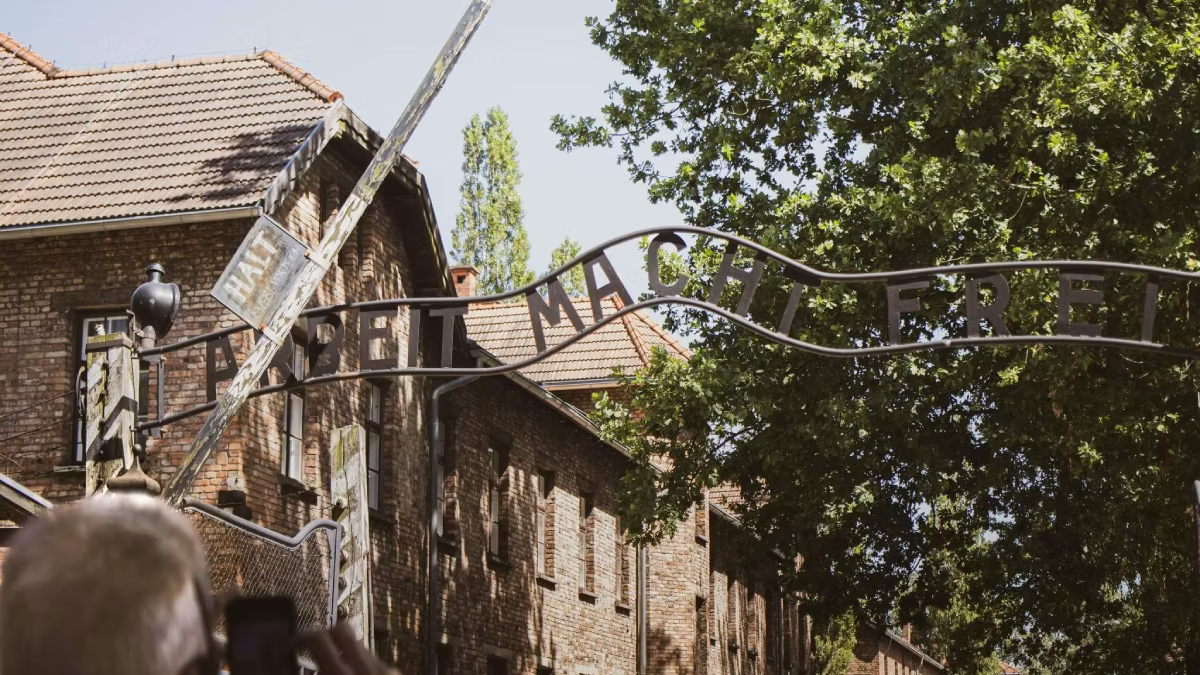
The “Arbeit Macht Frei” Gate at Auschwitz

The “Arbeit Macht Frei” gate — bearing the inscription meaning “Work Sets You Free” — stands at the entrance to Auschwitz I and is the most recognised symbol of the camp. The gate visible today is a replica; the original was stolen in 2009, later recovered and cut into three pieces, and is now held in secure storage by the museum. The gate was erected by the Nazis as a deliberate act of cynical deception — prisoners knew from the start that the promise it made was a lie.
No image of Auschwitz-Birkenau is more recognisable than the ironwork gate bearing those three words. Visitors have seen it in photographs, in films, in history books. Standing beneath it in person is something different entirely.
What the Inscription Means
“Arbeit macht frei” is a German phrase translating literally as “work makes (one) free” — or more naturally, “work sets you free.” The phrase predates its use at Auschwitz; it appeared as the title of an 1873 novel and was used by the Weimar-era German government in unemployment initiatives. Its use above the gates of Nazi concentration camps turned it into a symbol of industrial deception.
At Auschwitz I, the gate was erected under the direction of Rudolf Höss, the camp’s first commandant, in 1940. Prisoners were forced to walk beneath it each morning as they left for forced labour and each evening as they returned. For the vast majority, freedom never came through work. The inscription was a lie, displayed prominently and permanently as a framing statement about the camp’s entire purpose.
The irony — deliberate or unconsciously revealing — is that the “B” in “Arbeit” on the original gate was forged upside down by a prisoner metalworker. Whether this was intentional resistance or simply an error has never been definitively established. The detail is visible in photographs of the original gate.
The Gate’s History
The iron gate at Auschwitz I was installed in 1940 as part of the transformation of the former Polish army barracks into a concentration camp. It remained in place throughout the camp’s operation from 1940 to 1945.
After liberation and the establishment of the Auschwitz-Birkenau State Museum in 1947, the gate was preserved as part of the original site infrastructure. For decades it stood as the primary entrance to the museum grounds, walked beneath by millions of visitors.
The 2009 Theft and Recovery
In December 2009, the original “Arbeit Macht Frei” gate was stolen from Auschwitz I during the night. The theft caused international outrage and prompted a large-scale Polish police investigation.
The gate was recovered three days later, cut into three pieces, hidden in a house in northern Poland. Five men were subsequently convicted of the theft. Their motivations were never fully clarified publicly — though the theft was believed to have been carried out at the behest of a Swedish neo-Nazi.
The original gate, in its three recovered pieces, is now held in secure storage by the museum and is not publicly displayed. A replica — commissioned from the same materials and produced to exact specifications from the original — was installed in its place and is what visitors see today. The replica is otherwise identical to the original, including the upside-down “B.”
What Visitors See Today
The gate today stands at the entrance to Auschwitz I, between the main guardhouse and the first row of prisoner blocks. It is visible from the moment visitors enter the museum grounds and is the natural first point of the guided tour.
Walking beneath the gate — even knowing it is a replica — is one of the defining physical experiences of the visit. The gate is modest in scale: it is not monumental architecture. Its power comes from what it represented, from the context of the surrounding camp, and from the knowledge of what happened to those who walked beneath it.
Photography: Photography of the gate from the outside and inside is permitted and extremely common. The gate is the most photographed single object at the memorial. Many visitors photograph it on arrival before the guided tour begins; guided groups typically pass through it at the start of the tour.
The tour route: Every guided tour of Auschwitz I enters through or passes close to the gate. Your educator-guide will explain its history and the significance of the inscription as part of the tour’s opening context.
The Gate as Symbol
The “Arbeit Macht Frei” gate has become one of the most potent symbols of the Holocaust — a physical emblem of the Nazi regime’s capacity for cynical bureaucratic deception. It is recognised across the world even by people who know little else about Auschwitz-Birkenau specifically.
This recognition has consequences. The gate appears in references ranging from serious historical scholarship to popular culture to political commentary — and its ubiquity means it is often stripped of its specific context. Standing beneath it at Auschwitz I reattaches it to that context in a way that no image or reference can replicate.
Frequently Asked Questions
What does “Arbeit Macht Frei” mean?
The German phrase translates as “Work Sets You Free” or “Work Makes You Free.” It was erected above the entrance to Auschwitz I in 1940 and became one of the most recognised symbols of the Holocaust — a cynical Nazi inscription that promised freedom through labour while imprisoning and murdering those who walked beneath it.
Is the Arbeit Macht Frei gate the original?
No. The original gate was stolen in December 2009 and later recovered, but had been cut into three pieces. The damaged original is now held in secure storage by the museum. What visitors see today is a precise replica, manufactured to the same specifications as the original. It includes the upside-down “B” present on the original.
Who made the Arbeit Macht Frei sign?
The ironwork gate was fabricated by prisoner metalworkers at Auschwitz I under the direction of camp commandant Rudolf Höss in 1940. The upside-down “B” in “Arbeit” was forged by a prisoner — whether as deliberate resistance or an error has never been definitively confirmed.
Where is the original Arbeit Macht Frei gate?
The original gate, cut into three pieces during the 2009 theft, is held in secure storage by the Auschwitz-Birkenau State Museum. It is not on public display.
Can you photograph the Arbeit Macht Frei gate?
Yes. Photography of the gate is permitted and is among the most common photographs taken at the memorial. Personal photography without flash or tripod is permitted throughout the exterior and interior of Auschwitz I, with the exception of the hair room in Block 4 and the basement of Block 11.
