
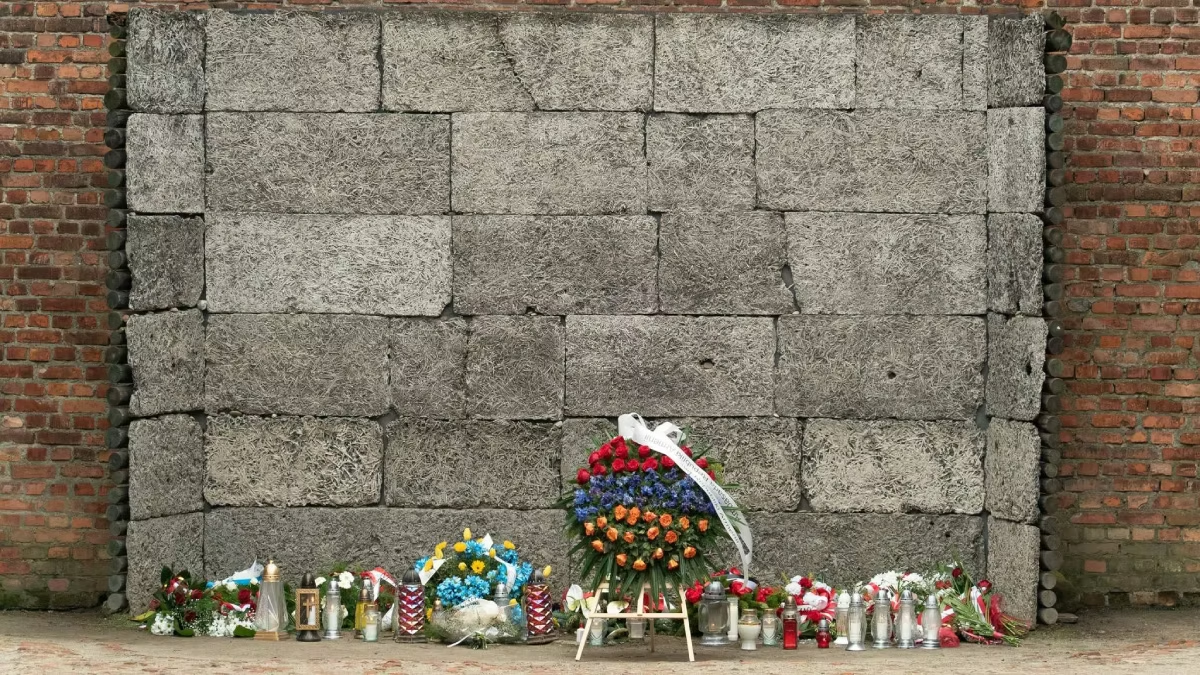
The International Monument to the Victims of Fascism at Auschwitz-Birkenau

The International Monument to the Victims of Fascism stands between the ruins of Crematoria II and III at the far end of the Birkenau railway ramp. Unveiled in 1967, it consists of a series of large stone memorial slabs bearing inscriptions in the languages of the nations whose citizens were murdered at Auschwitz-Birkenau. It is the site of the annual Liberation Day commemoration on 27 January and the concluding point of most guided tours of Birkenau.
Every guided tour of Auschwitz-Birkenau ends here. After the main gate, the railway ramp, the barracks, and the crematorium ruins, the group gathers at the International Monument for a period of silence before leaving the site. It is a deliberate conclusion — a formal act of acknowledgement that the visit is not simply a historical exercise, but a form of bearing witness.
History of the Monument
In the years after liberation, the Auschwitz-Birkenau State Museum began the process of preserving the site and establishing it as a permanent memorial. The question of how to formally commemorate the victims — and how to represent the international scope of those murdered there — led to the creation of the International Monument.
The monument was designed by a group of Italian and Polish artists led by Oskar Hansen and Pietro Cascella. It was unveiled on 16 April 1967, during a ceremony attended by delegations from across Europe.
The design consists of a large central stone platform — a kind of altar or stage — flanked by a series of tall stone slabs. The slabs bear inscriptions in 19 languages, each expressing the same message of remembrance in the language of a nation whose citizens were murdered at Auschwitz-Birkenau: Polish, English, French, German, Russian, Hebrew, Yiddish, Hungarian, Czech, Slovak, Dutch, Greek, Italian, Romanian, Bulgarian, Serbian, Norwegian, Danish, and Finnish.
The monument does not name individual victims — the scale of the murder makes individual commemoration impossible at this location. Instead it speaks collectively, and in multiple languages simultaneously, to the international character of the crime.
Location and Setting
The monument stands between the ruins of Crematoria II and III, at the end of the railway ramp, approximately 500 metres from the main Birkenau gate. It occupies the most significant geographical position at the entire memorial: the point at which the railway track ends, flanked on both sides by the destroyed gas chambers that were the destination of those who arrived on that track.
The setting gives the monument its weight. It is not a sculpture in a garden or a plaque on a wall — it is a memorial placed at the exact location where the killing took place, surrounded by its physical evidence. Flowers, memorial candles, stones, and wreaths are placed at the monument year-round by visitors, survivors, and official delegations.
The 27 January Commemoration
The most significant annual event at the International Monument is the Liberation Day ceremony on 27 January — the anniversary of the liberation of Auschwitz-Birkenau by Soviet forces on 27 January 1945. This date is now observed internationally as Holocaust Remembrance Day.
Each year, the ceremony at the monument is attended by survivors of the camp, heads of state and government, religious leaders, and official delegations from across the world. In 2020, the 75th anniversary of liberation was attended by over 200 survivors and more than 50 world leaders.
Visiting on 27 January: The museum remains open on this date but access may be restricted during the ceremony itself. If your visit falls on or near 27 January, check the museum’s official announcements well in advance at auschwitz.org.
The Monument as a Closing Point
For most visitors, arriving at the International Monument at the end of the guided tour is a moment of considerable emotional complexity. The preceding hours — the exhibition blocks at Auschwitz I, Block 11, the gas chamber at Crematorium I, the railway ramp, the barracks, the crematorium ruins — have accumulated into an experience that is difficult to summarise or resolve.
The monument does not attempt to resolve it. The inscriptions do not explain or contextualise; they simply bear witness, in 19 languages, to what happened here. The silence that falls over a guided tour group at the monument — without anyone being asked to be silent — is one of the most consistently reported experiences of the Birkenau visit.
Most educator-guides close the tour with a brief address at the monument before inviting the group to stand in silence. There is no prescribed duration. The group disperses when it is ready.
Practical Information
Location: End of the Birkenau railway ramp, between the ruins of Crematoria II and III. Approximately 500 metres from the main Birkenau gate, reached by walking the length of the ramp.
Access: The monument is accessible to all visitors on guided and self-guided visits. It is the concluding stop of the standard 3.5-hour guided tour.
Photography: Photography at the monument is permitted. Many visitors photograph the stone inscriptions in their own language, the wreaths and memorial candles, and the surrounding ruins. There are no photography restrictions at this location.
Flowers and memorials: Visitors frequently leave flowers, stones, and candles at the monument. This is welcomed and appropriate.
Frequently Asked Questions
What is the International Monument at Auschwitz-Birkenau?
The International Monument to the Victims of Fascism is a large stone memorial unveiled in 1967, located between the ruins of the Birkenau crematoria at the end of the railway ramp. It bears inscriptions in 19 languages commemorating the victims of the nations murdered at Auschwitz-Birkenau. It is the concluding point of most guided tours and the site of the annual 27 January Liberation Day ceremony.
Why is the monument at the end of the railway ramp?
The location is deliberate — the monument stands at the point where the railway track ends, between the ruins of the gas chambers that were the destination of those who arrived on that track. Placing the memorial at the site of the killing, rather than at a distance from it, is a specific decision about the relationship between commemoration and historical truth.
What languages are on the International Monument?
The monument bears inscriptions in 19 languages: Polish, English, French, German, Russian, Hebrew, Yiddish, Hungarian, Czech, Slovak, Dutch, Greek, Italian, Romanian, Bulgarian, Serbian, Norwegian, Danish, and Finnish — the languages of the principal nations whose citizens were murdered at Auschwitz-Birkenau.
When is the Liberation Day ceremony at Auschwitz?
The annual ceremony commemorating the liberation of Auschwitz-Birkenau by Soviet forces is held on 27 January each year. It takes place at the International Monument and is attended by survivors, world leaders, and official delegations. 27 January is observed internationally as Holocaust Remembrance Day.
Can I leave flowers or candles at the monument?
Yes. Visitors are welcome to leave flowers, memorial candles, stones, and wreaths at the International Monument. This is a common and entirely appropriate form of personal commemoration.
