
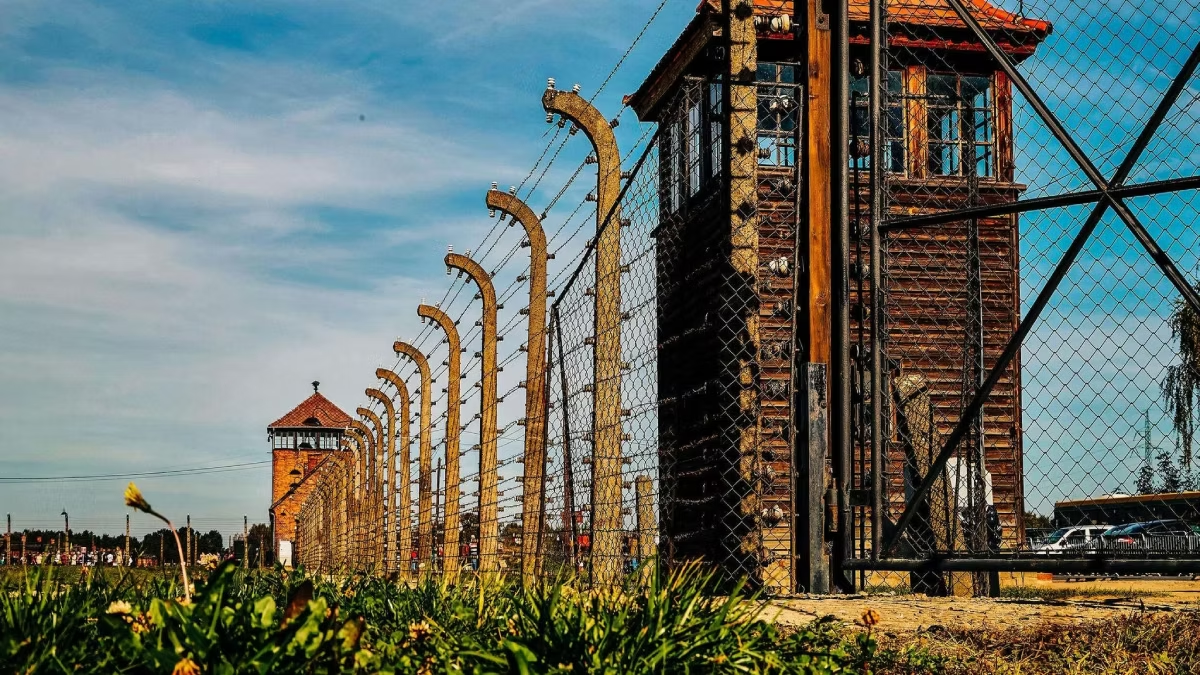
Auschwitz II-Birkenau: Complete Visitor Guide

Auschwitz II-Birkenau is the larger of the two main sites at the memorial — a purpose-built extermination and concentration camp spanning nearly 175 hectares, where the vast majority of the over 1.1 million people murdered at Auschwitz were killed. Key sites include the main gate and watchtower, the railway ramp, the prisoner barracks, the ruins of the gas chambers and crematoria, and the International Monument to the Victims. A standard visit to Birkenau takes approximately 1.5–2 hours as part of the 3.5-hour guided tour.
If Auschwitz I is where the machinery of murder was developed, Birkenau is where it was deployed at its most horrific scale. The two sites are connected by the same history and the same guided tour, but they are physically and experientially very different. Auschwitz I is compact, institutional, enclosed. Birkenau is vast, open, and almost incomprehensibly large — a flat expanse of former marshland covering the area of a small town, most of which was once filled with prisoner barracks, gas chambers, and the infrastructure of industrial killing.
Understanding what Birkenau is — before you arrive — makes the visit both more comprehensible and more bearable.
Background: What Was Birkenau?
Auschwitz II-Birkenau was constructed from late 1941 on the site of the demolished village of Brzezinka (Birkenau in German), approximately 3 km from Auschwitz I. It was built initially to hold Soviet prisoners of war, but its function evolved rapidly as the Nazi regime accelerated its programme of mass murder.
From 1942 onwards, Birkenau became the primary destination for the deportation transports arriving from across German-occupied Europe. Trains brought Jewish men, women, and children from Poland, Hungary, France, the Netherlands, Greece, Belgium, Italy, and dozens of other nations. On arrival at the railway ramp, SS physicians conducted selections: those deemed capable of forced labour were registered and entered the camp; the remainder — typically 70–80% of each transport, including virtually all children under 15, their mothers, the elderly, and anyone deemed unfit for work — were taken directly to the gas chambers.
At the peak of the killing operation in the summer of 1944 — during the deportation of Hungarian Jews — up to 10,000 people were murdered at Birkenau each day.
The camp covered nearly 175 hectares and at its height contained over 300 prisoner barracks. Today, the majority of those barracks no longer exist — most were demolished or burned by the SS before liberation, or fell into disrepair in the decades afterwards. What remains are the brick chimneys that once supported the barracks roofs, standing in rows across the empty field — one of the most affecting sights at the entire memorial.
The Main Gate and Watchtower
The visit to Birkenau begins at the main gate — a large brick building with an arched central passage through which the railway line entered the camp. This gate, with its distinctive watchtower, is among the most recognisable images of the Holocaust.
Visitors can climb to the top of the watchtower, which provides the clearest view of the full scale of Birkenau — the railway track stretching into the distance, the rows of chimneys across the vast site, the ruins of the crematoria visible at the far end of the camp. Many visitors find this view the single most affecting moment of the entire visit. The scale of what they are looking at — knowing that this entire space was operational within their parents’ or grandparents’ lifetime — is almost impossible to absorb from ground level.
The Railway Ramp
The railway line runs directly through the main gate and along the central road of the camp to the end of the site, where it terminates at the area once used for selections. This is the railway ramp — the platform where arriving deportees disembarked from the transport trains and were subjected to the selection process.
The ramp is visited as part of the standard guided tour. Your educator-guide will explain the selection process, the criteria applied by the SS physicians, and the specific statistics of how many people from each transport were registered as prisoners versus taken directly to the gas chambers.
The railway tracks, ramp platform, and surrounding area are preserved in their original state. See our dedicated railway ramp at Birkenau article for the full history.
The Prisoner Barracks
Birkenau contained both wooden barracks (originally designed as horse stables) and brick barracks. Both types are preserved and open to visitors.
The wooden barracks — in the section designated as BIa and BIb (the women’s camp) — each held up to 800 prisoners in three-tier wooden bunks. The barracks were designed for 52 horses; prisoners were packed in at a density that made disease, starvation, and death from exhaustion endemic from the first weeks of incarceration.
The brick barracks — visible in other sections of the camp — provided marginally more structural permanence but conditions were equally brutal.
Across most of the site, only the brick chimney stacks survive where barracks once stood. Walking among the rows of chimneys across the empty field — understanding that each chimney marks the location of a former barrack that housed hundreds of people — is one of the defining experiences of the Birkenau visit.
See our dedicated prisoner barracks at Birkenau article for full details.
The Gas Chambers and Crematoria
At the far end of the railway ramp, beyond the end of the tracks, stand the ruins of Crematoria II and III — the largest of the four gas chamber and crematorium complexes built at Birkenau. These are not preserved buildings; the SS dynamited all four crematoria in late 1944 as Soviet forces approached. What visitors see are the collapsed ruins — broken concrete, twisted reinforcing rods, the outlines of the underground gas chambers and changing rooms still visible beneath the debris.
The ruins of Crematoria IV and V stand on the opposite side of the camp. A small pond adjacent to the ruins was used to dispose of the ashes of victims.
Standing among the ruins of the crematoria — knowing that these buildings were deliberately destroyed by those who operated them in an attempt to hide what they had done — is a specific and important moment of the visit. The destruction itself is evidence: people who were innocent of wrongdoing do not dynamite their own facilities as armies approach.
See our dedicated gas chambers and crematoria at Birkenau article for the full history of each crematorium.
The International Monument to the Victims
The International Monument to the Victims of Fascism stands between the ruins of Crematoria II and III at the far end of the railway ramp. It was unveiled in 1967 and consists of a series of large stone memorial slabs bearing inscriptions in the languages of the nations whose citizens were murdered at Auschwitz-Birkenau.
The monument is the site of official commemorations, including the annual Liberation Day ceremony on 27 January. It is where most guided tours conclude their visit to Birkenau — with a period of silence at the monument before returning to the entrance.
See our dedicated International Monument article for full details.
The Kanada Warehouses
The Kanada complex — a series of warehouse barracks where the property confiscated from arriving prisoners was sorted, catalogued, and stored before shipment back to Germany — is located in the northwest corner of the Birkenau camp. The name “Kanada” was given by prisoners, for whom Canada represented a land of abundance.
The Kanada warehouses are accessible on the 6-hour study tour but are not included on the standard 3.5-hour guided tour. See our dedicated Kanada warehouses article for details.
Practical Information for Birkenau
How to get there: Birkenau is reached from Auschwitz I via the free museum shuttle bus (approximately 10 minutes), included for all visitors on guided tours. Visitors with cars can drive the 3.5 km between sites — a car park is available near the Birkenau gate. See our shuttle bus guide for details.
Duration: Allow approximately 1.5–2 hours at Birkenau as part of the standard 3.5-hour guided tour. The site is large and involves significant walking — the distance from the main gate to the International Monument and back is approximately 2–3 km.
Weather and clothing: Much of the Birkenau visit takes place outdoors, across an open exposed site with little shelter. Dress for the weather — warm layers in winter, sun protection in summer, waterproofs in rain. See our what to wear and bring guide for full advice.
Photography: Permitted throughout the Birkenau site without flash or tripod. There are no photography prohibitions at Birkenau equivalent to those at Auschwitz I.
Frequently Asked Questions
What is Auschwitz II-Birkenau?
Auschwitz II-Birkenau was the largest of the Nazi extermination camps, built from 1941 on the site of the demolished village of Brzezinka, approximately 3 km from Auschwitz I. It was the primary site of mass murder at the Auschwitz complex — where the majority of the over 1.1 million people killed at Auschwitz were murdered, most of them in the gas chambers immediately on arrival.
How big is Birkenau?
Birkenau covered approximately 175 hectares at its height — roughly the size of a small town. At its peak it contained over 300 prisoner barracks. Today most of those barracks are gone, but their locations are marked by the rows of brick chimney stacks visible across the site.
How long does a visit to Birkenau take?
As part of the standard 3.5-hour guided tour of both sites, approximately 1.5–2 hours is spent at Birkenau. Self-guided visitors often spend 2–3 hours exploring the site independently.
Is Birkenau different from Auschwitz I?
Yes — significantly. Auschwitz I is a compact, enclosed institutional site of brick blocks housing exhibitions. Birkenau is vast, open, and largely outdoor — a former marshland site where the scale of the operation is conveyed by the physical expanse of the grounds rather than by exhibitions. Most visitors find Birkenau more emotionally affecting than Auschwitz I, because the sheer size of what they are standing in becomes physically real.
Can you walk around Birkenau freely?
Yes. The site is open to walk around. On a guided tour your educator-guide leads the group through the key locations in a structured sequence. Self-guided visitors can walk the site freely using the museum’s maps and the exhibition panels at key locations.
